
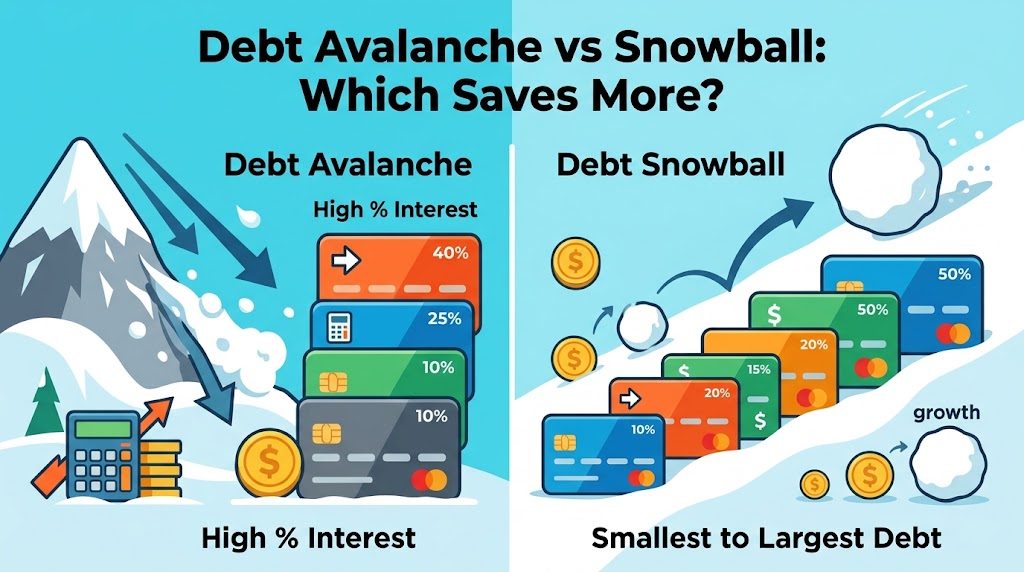
Debt avalanche vs snowball comes down to one question: do you want to pay the least interest, or get your first win sooner? On the four debts in our example ($18,800 in total, with an extra $400 a month), the avalanche saves $754 in interest and finishes one month earlier, while the snowball clears the first debt in month 5 instead of month 7.
The gap is smaller than most people expect, and it changes with your interest rates. This guide shows the full numbers, what the research says, how Dave Ramsey’s advice fits in, and how debt consolidation compares. To model any single debt, use our debt payoff calculator.
Last reviewed: October 11, 2026. For education only; this is not financial advice.
Debt avalanche vs snowball: how each method works
In the debt avalanche vs snowball comparison, both methods start the same way: pay the minimum on every debt, then put all your extra money on one target debt. When that debt is gone, its payment moves to the next one. They differ only in which debt is the target.
- Debt avalanche: target the debt with the highest interest rate first. This costs the least interest.
- Debt snowball: target the debt with the smallest balance first, whatever its rate. You clear whole debts faster, which many people find motivating.
Debt avalanche vs snowball example: $18,800 of debt, an extra $400 a month
These are hypothetical debts, with no new charges added and interest figured monthly at the annual rate divided by 12:
| Debt | Balance | Interest rate | Minimum payment |
|---|---|---|---|
| Store card | $1,800 | 17% | $50 |
| Credit card 2 | $3,000 | 29% | $90 |
| Personal loan | $5,000 | 11% | $120 |
| Credit card 1 | $9,000 | 24% | $230 |
| Total | $18,800 | 20.67% weighted average | $490 |
The total monthly budget is $890: the $490 of minimums plus $400 extra. Snowball order is store card, credit card 2, personal loan, credit card 1 (by balance). Avalanche order is credit card 2, credit card 1, store card, personal loan (by rate).
| Method | Debt-free in | Total interest | First debt cleared |
|---|---|---|---|
| Minimum payments only | 66 months | $13,306 | Month 51 |
| Debt snowball + $400 | 27 months | $4,954 | Month 5 |
| Debt avalanche + $400 | 26 months | $4,200 | Month 7 |
| Debt | Paid off in month (snowball) | Paid off in month (avalanche) |
|---|---|---|
| Store card | 5 | 23 |
| Credit card 2 (29%) | 11 | 7 |
| Personal loan | 17 | 26 |
| Credit card 1 (24%) | 27 | 21 |
The avalanche wins on cost because it attacks the 29% card first and the 24% card next, so the most expensive balances stop growing sooner. The snowball pays off the store card in 5 months, but it leaves the two highest-rate cards for last.
In debt avalanche vs snowball, the extra payment matters most
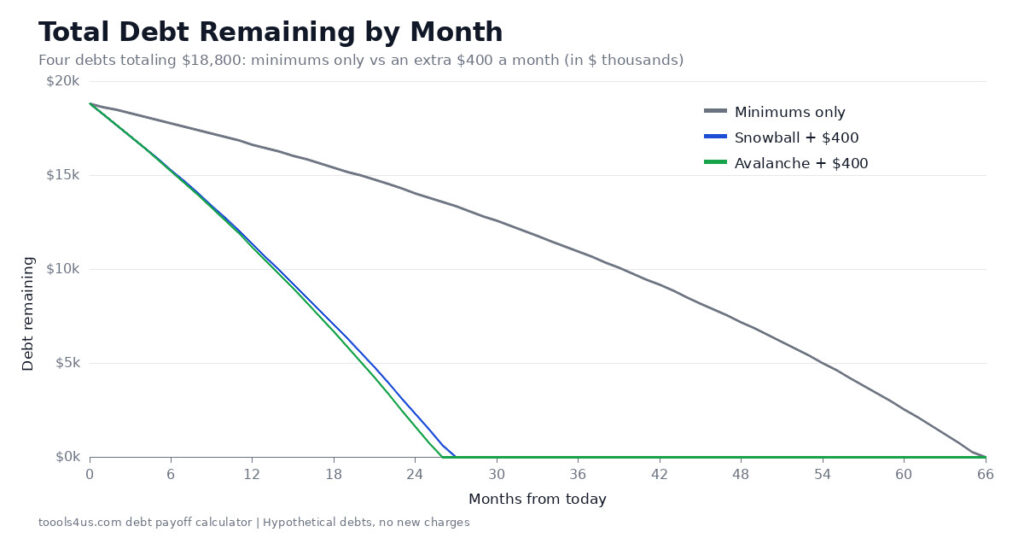
Look at the debt avalanche vs snowball chart: the snowball and avalanche lines are close together, and both are far below the minimum-payments line. Compared with paying only the minimums, the extra $400 saves $8,351 in interest with the snowball and $9,105 with the avalanche. The choice between the two methods is worth $754; the decision to pay extra is worth about $8,000 to $9,000.
The calculator on our site handles one debt at a time, so to check each debt in your own list, run its balance, rate and payment through the debt payoff calculator and see how much each extra dollar saves.
When the gap between debt snowball and avalanche is small
In a debt avalanche vs snowball race, the avalanche saves more when your rates are far apart. If we keep the same balances and minimums but change the rates to 20%, 21%, 22% and 23%, the result is nearly a tie: the snowball costs $5,131 in interest, the avalanche $5,006, a difference of $125, and both finish in 27 months.
Research points the same way. Marketing researchers David Gal and Blakeley McShane at Northwestern’s Kellogg School studied almost 6,000 clients of a debt settlement firm and published the results in the Journal of Marketing Research in 2012. Clients who closed more accounts were more likely to finish the program, and paying off small accounts first helped people get started. The authors also say that, in pure math, paying the highest-interest debt first minimizes interest, and that starting small makes most sense when the rates on the small and large balances differ only modestly. The data came from one settlement firm’s clients, so it shows a pattern, not a rule for everyone.
Debt avalanche vs snowball: which is better for you?
Choose the avalanche if your rates differ a lot (for example 29% against 11%), you are motivated by the numbers, and you will stay on the plan even when the first debt takes a year to clear.
Choose the snowball if you have a small balance that you can clear within a few months, you have started and stopped debt plans before, or you need visible progress to keep going. It costs more when rates differ widely, so check the price with the example above: here it is $754.
A third option sits between them: use the avalanche, but clear any tiny balance first if it is only a few months of payments. You get an early win and give up little interest.
Does Dave Ramsey recommend the snowball or avalanche?
Ramsey Solutions recommends the debt snowball. Its steps are to list your debts from smallest balance to largest, ignoring the interest rates, pay the minimum on everything except the smallest, put every spare dollar on the smallest debt, then roll that payment onto the next one. It acknowledges that the avalanche may save a little more interest on paper, but argues that quick wins build momentum, and that behavior matters more than math in getting out of debt.
That is a view about motivation, not a claim that the snowball is cheaper. On our example it costs $754 more than the avalanche, which is the price of the earlier wins. Whether it is worth that price depends on whether you would otherwise keep going.
Debt consolidation vs snowball
Consolidation and the snowball answer different questions. The snowball and the avalanche decide the order in which you pay your debts. Consolidation replaces several debts with one new one. You can consolidate and then still choose how much extra to pay.
The Consumer Financial Protection Bureau describes three common routes and their risks:
- Balance transfer card: often a low or zero promotional rate, but there is usually a transfer fee, and the rate can rise after the promotion ends.
- Debt consolidation loan: one payment, sometimes at a lower rate, but a lower monthly payment often means a longer term, which can cost more overall once interest and fees are counted.
- Home equity loan: your home becomes collateral, so missed payments could lead to foreclosure, and closing costs can be significant.
A simple test: take the weighted average rate on your debts (20.67% in our example) and compare it with the all-in rate of the new loan, including fees. The Federal Reserve reported an average of 22.36% on credit card accounts assessed interest in August 2026 (preliminary), so card debt can be costly, but consolidation helps only if the new rate is clearly lower and you do not run the cards back up. Compare real offers with the personal loan calculator and use the total cost over the full term, not just the monthly payment.
Is the debt snowball a good idea?
Yes, if it is the plan you will actually follow. Its weakness is cost: because it ignores interest rates, it can leave your most expensive debt for last. Its strength is that finishing a whole debt in a few months is easy to see and to repeat. If your highest-rate debt is also a small one, the snowball and the avalanche are the same plan.
Which debt payoff method is best?
In the debt avalanche vs snowball choice, the best method is the one you complete. The avalanche is the cheapest in theory, the snowball is built for motivation, and a consolidation loan can lower your rate if the all-in cost is truly lower. Whichever you pick, three habits matter more than the label: pay every minimum on time, add a fixed extra amount every month, and stop adding new charges to the debts you are paying off.
If you also have a mortgage and wonder where extra money should go, see our guide to the 15 year vs 30 year mortgage. High-rate card debt usually costs more than a mortgage, but compare the real rates.
Five steps to start this week
- List every debt with its balance, interest rate and minimum payment.
- Decide your fixed extra payment, even if it is small, and add it to the total budget.
- Pick a target: highest rate (avalanche) or smallest balance (snowball).
- Set automatic minimum payments on everything so none is missed.
- When a debt is paid off, move its whole payment to the next target.
Debt avalanche vs snowball questions
Which is better, debt snowball or debt avalanche?
The avalanche costs less interest; the snowball gives faster wins. On $18,800 of debt with $400 extra a month, the avalanche saves $754 and one month. If your rates are close together, the difference shrinks, in our second example to $125.
Which is better, debt consolidation or snowball?
They are different tools. Consolidation replaces your debts with one new loan and helps only if its all-in rate, including fees, is clearly lower than your current average. The snowball is a payment order that works with or without consolidation.
Does Dave Ramsey recommend the snowball or avalanche method?
The snowball. Ramsey Solutions says to pay debts from smallest balance to largest, ignoring interest rates, because quick wins build momentum.
Which debt payoff method is best?
The one you will finish. Use the avalanche if rates differ a lot and you are motivated by savings, or the snowball if you need early wins.
Is the debt snowball a good idea?
Yes if it keeps you paying. It can cost more in interest, $754 more in our example, but only a plan you stick to pays off debt.
The takeaway
In the debt avalanche vs snowball choice, the avalanche saved $754 on our $18,800 example and the snowball cleared the first debt two months sooner. Both beat minimum payments by about $8,000 to $9,000 in interest. Pick the order you will follow, add a fixed extra payment, and check each debt in the debt payoff calculator.
Sources
- Kellogg Insight: To Beat Debt, Consider Starting Small (Gal and McShane, Journal of Marketing Research, 2012)
- Ramsey Solutions: How the debt snowball method works
- CFPB: What do I need to know about consolidating my credit card debt?
- Federal Reserve G.19: Consumer Credit