
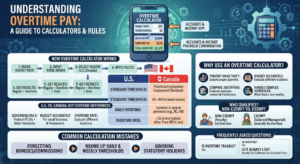
Overtime Calculator: US & Canada Overtime Rules (2026)
Figuring out exactly how much extra you should be paid for working past your regular hours isn’t always straightforward. Overtime rules differ by country, by state or province, and sometimes even by industry, which is why an overtime calculator has become one of the most searched tools among hourly employees, freelancers moving into contract work, and small business owners trying to run payroll correctly. Whether you’re in Chicago, Toronto, or anywhere in between, understanding how overtime pay is calculated can save you from being underpaid — or help you budget your payroll accurately if you’re the one writing the checks.
Table of Contents
What Is an Overtime Calculator?
An overtime calculator is a simple tool that takes your regular hourly wage, the number of hours you worked, and the overtime rules that apply to your situation, then tells you exactly how much you should be paid. Instead of manually multiplying your hourly rate by 1.5 and trying to remember which hours count as “overtime,” the calculator does the math instantly and accurately.
This matters more than people think. Wage and overtime violations remain one of the most common workplace complaints filed with the U.S. Department of Labor’s Wage and Hour Division, often because employees (and even employers) simply miscalculate what’s owed. Using a dedicated overtime pay calculator removes the guesswork and gives you a number you can trust before your paycheck arrives.
How Overtime Pay Works in the United States
In the U.S., overtime is governed primarily by the Fair Labor Standards Act (FLSA). The core rule is simple on paper: non-exempt employees must be paid at least 1.5 times their regular hourly rate for any hours worked beyond 40 in a single workweek. There is no daily overtime threshold under federal law — it’s strictly a weekly calculation.
That said, several states apply stricter rules:
- California requires overtime pay after 8 hours in a single day, not just after 40 hours in a week, and even offers double time (2x pay) after 12 hours in a day.
- Alaska, Nevada, and Colorado also have daily overtime thresholds that differ from the federal standard.
- Most other states simply follow the federal 40-hour weekly rule.
To calculate your overtime pay manually in a state that follows federal rules:
- Determine your regular hourly rate.
- Subtract 40 from your total hours worked in the week to find your overtime hours.
- Multiply your overtime hours by 1.5x your hourly rate.
- Add that to your regular pay (40 hours x your hourly rate).
For example, if you earn $20/hour and worked 46 hours in one week:
- Regular pay: 40 x $20 = $800
- Overtime pay: 6 x $30 (1.5 x $20) = $180
- Total pay: $980
An overtime calculator handles this instantly, and it becomes especially useful when your schedule varies week to week or when you’re comparing pay across different states.
How Overtime Pay Works in Canada
Canadian overtime rules are set at the provincial level, which means the rules can look quite different depending on where you work. There’s no single federal overtime standard that applies to most private-sector employees — only federally regulated industries like banking and telecommunications follow the federal standard instead of provincial rules.
Here’s a quick comparison of common provincial overtime thresholds:
- Ontario: Overtime kicks in after 44 hours per week, paid at 1.5x the regular rate.
- British Columbia: Overtime applies after 8 hours in a day (1.5x) and after 12 hours in a day (2x), plus after 40 hours in a week.
- Alberta: Overtime is owed after 8 hours in a day or 44 hours in a week, whichever gives the employee more pay.
- Quebec: The standard threshold is 40 hours per week at 1.5x pay.
Because these numbers vary so much by province, Canadian workers benefit even more from using an overtime calculator that lets them input their specific province rather than relying on a single generic formula.
US vs. Canada: Key Differences to Know
| Factor | United States | Canada |
|---|---|---|
| Governing rule | Federal (FLSA) + state variations | Provincial employment standards |
| Standard threshold | 40 hrs/week | 40–44 hrs/week (varies by province) |
| Daily overtime | Only in select states (e.g., California) | Common in several provinces (e.g., BC, Alberta) |
| Overtime rate | 1.5x standard | 1.5x standard (some regions allow time off in lieu) |
One interesting difference: several Canadian provinces allow “time off in lieu” — banking overtime hours as paid time off instead of receiving extra cash — an option that’s far less common in the U.S. under the FLSA.
Who Actually Qualifies for Overtime?
Not everyone is entitled to overtime pay, and this is where a lot of confusion happens. In the U.S., employees are generally split into two categories:
- Non-exempt employees — typically hourly workers — are entitled to overtime.
- Exempt employees — usually salaried employees in executive, administrative, or professional roles earning above a certain salary threshold — are not entitled to overtime under federal law.
In Canada, exemptions also exist for certain managerial, supervisory, and professional roles, though the specific criteria differ by province. If you’re unsure which category you fall into, checking your provincial or state labor board website (or asking HR directly) is the safest first step before running your numbers through a calculator.
Why Freelancers and Contractors Should Care Too
If you’re self-employed or work on a contract basis, overtime laws generally don’t apply to you the same way — but that doesn’t mean the math isn’t useful. Many freelancers use an overtime-style calculation to decide how much to charge clients for rush work or hours beyond an agreed scope. Applying a similar 1.5x or 2x multiplier to your standard rate is a common and fair way to price extra effort, and it mirrors exactly what a traditional overtime calculator computes.
If you’re building out your freelance pricing structure, it’s also worth checking a freelance rate calculator to make sure your base hourly rate is sustainable before you start layering overtime premiums on top of it.
Common Overtime Calculation Mistakes
Even with a calculator, it helps to understand where errors typically creep in:
- Forgetting bonuses and commissions. Under FLSA rules, certain non-discretionary bonuses must be factored into your “regular rate” before the 1.5x multiplier is applied — not just your base hourly wage.
- Mixing up daily and weekly thresholds. Someone working in California but assuming the standard 40-hour federal rule applies could significantly underestimate what they’re owed.
- Not accounting for different pay rates in the same week. If you worked two different jobs — or two different pay rates — for the same employer in one week, the “blended rate” method typically applies.
- Ignoring statutory holidays. In many Canadian provinces, hours worked on a statutory holiday may require premium pay on top of standard overtime rules.
How to Use an Overtime Calculator Correctly
To get an accurate result, gather this information before you start:
- Your regular hourly wage (or salary converted to an hourly rate).
- Total hours worked in the pay period.
- Your state or province, since thresholds vary.
- Any bonuses or commissions earned that week, if applicable.
Once you have these details, a good calculator will instantly show your regular pay, overtime pay, and total gross pay — no spreadsheet required. This is especially useful before a big paycheck, when negotiating a new hourly rate, or when double-checking that your employer calculated things correctly.
If you’re also tracking your broader income, it’s worth pairing your overtime numbers with a paycheck calculator to see your estimated take-home pay after taxes, or a tax bracket calculator if extra overtime hours are pushing you into a higher bracket for the year.
Frequently Asked Questions
Does overtime pay count as taxable income? Yes. Overtime pay is taxed the same way as your regular wages — it’s simply added to your total taxable income for that pay period, though it can sometimes push you into a higher withholding bracket temporarily.
Is overtime pay always 1.5x? In most cases, yes, both in the U.S. and Canada. However, some jurisdictions apply “double time” (2x) after extended daily hours, such as California after 12 hours in a day.
Do salaried employees ever get overtime? It depends on whether they’re classified as exempt or non-exempt. Many salaried employees below a certain income threshold are still legally entitled to overtime pay.
Can my employer give me time off instead of overtime pay? In the U.S., this is generally not allowed for private-sector non-exempt employees. In several Canadian provinces, banked time off in lieu of overtime pay is permitted if both parties agree.
Final Thoughts
Whether you’re an hourly employee trying to confirm your next paycheck, a small business owner running payroll, or a freelancer pricing rush jobs, understanding how overtime pay is calculated protects both your income and your compliance with labor law. Because the rules shift depending on whether you’re working under U.S. federal and state law or Canadian provincial law, using a dedicated overtime calculator — rather than relying on a single generic formula — is the fastest way to get an accurate, trustworthy number every time.