
Most salaried employees know their annual pay but not what they earn per hour. The quick answer: divide your annual salary by 2,080, the number of hours in a standard full-time year (40 hours a week for 52 weeks). A $72,000 salary, for example, works out to about $34.62 an hour.
Want your exact number, including your real weekly hours? Use our free Salary to Hourly Calculator. Below you will find the formula, a 2026 salary-to-hourly chart, monthly examples, and why your real hours can change the answer.
Last reviewed: October 9, 2026. All hourly figures are gross, before taxes.
The Salary to Hourly Formula
The math is straightforward:
Hourly rate = Annual salary ÷ (hours per week × weeks per year)
The common shortcut is dividing by 2,080 (40 hours × 52 weeks). It is accurate only if you truly work exactly 40 hours a week with no unpaid time off. If your schedule is different, enter your real hours in the Salary to Hourly Calculator instead of assuming 40.
Salary to Hourly Chart (2,080 Hours a Year)
This chart converts common annual salaries to hourly, weekly, biweekly and monthly pay using 2,080 hours. It includes popular amounts people search for, such as $72,000, $74,000 and $104,000 a year.
| Annual salary | Hourly | Weekly | Biweekly | Monthly |
|---|---|---|---|---|
| $27,000 | $12.98 | $519.23 | $1,038.46 | $2,250.00 |
| $30,000 | $14.42 | $576.92 | $1,153.85 | $2,500.00 |
| $35,000 | $16.83 | $673.08 | $1,346.15 | $2,916.67 |
| $40,000 | $19.23 | $769.23 | $1,538.46 | $3,333.33 |
| $45,000 | $21.63 | $865.38 | $1,730.77 | $3,750.00 |
| $50,000 | $24.04 | $961.54 | $1,923.08 | $4,166.67 |
| $55,000 | $26.44 | $1,057.69 | $2,115.38 | $4,583.33 |
| $60,000 | $28.85 | $1,153.85 | $2,307.69 | $5,000.00 |
| $61,000 | $29.33 | $1,173.08 | $2,346.15 | $5,083.33 |
| $65,000 | $31.25 | $1,250.00 | $2,500.00 | $5,416.67 |
| $70,000 | $33.65 | $1,346.15 | $2,692.31 | $5,833.33 |
| $72,000 | $34.62 | $1,384.62 | $2,769.23 | $6,000.00 |
| $74,000 | $35.58 | $1,423.08 | $2,846.15 | $6,166.67 |
| $75,000 | $36.06 | $1,442.31 | $2,884.62 | $6,250.00 |
| $80,000 | $38.46 | $1,538.46 | $3,076.92 | $6,666.67 |
| $85,000 | $40.87 | $1,634.62 | $3,269.23 | $7,083.33 |
| $90,000 | $43.27 | $1,730.77 | $3,461.54 | $7,500.00 |
| $95,000 | $45.67 | $1,826.92 | $3,653.85 | $7,916.67 |
| $100,000 | $48.08 | $1,923.08 | $3,846.15 | $8,333.33 |
| $104,000 | $50.00 | $2,000.00 | $4,000.00 | $8,666.67 |
| $110,000 | $52.88 | $2,115.38 | $4,230.77 | $9,166.67 |
| $120,000 | $57.69 | $2,307.69 | $4,615.38 | $10,000.00 |
| $130,000 | $62.50 | $2,500.00 | $5,000.00 | $10,833.33 |
| $150,000 | $72.12 | $2,884.62 | $5,769.23 | $12,500.00 |
Going the other direction? Use the hourly to salary calculator.
Monthly Salary to Hourly
If you are paid by the month, multiply by 12 to get the annual figure, then divide by 2,080. For example, $5,000 a month is $60,000 a year, or about $28.85 an hour.
| Monthly salary | Hourly (2,080 hours) | Annual |
|---|---|---|
| $2,000 | $11.54 | $24,000 |
| $2,500 | $14.42 | $30,000 |
| $3,000 | $17.31 | $36,000 |
| $3,500 | $20.19 | $42,000 |
| $4,000 | $23.08 | $48,000 |
| $4,100 | $23.65 | $49,200 |
| $4,500 | $25.96 | $54,000 |
| $5,000 | $28.85 | $60,000 |
| $5,500 | $31.73 | $66,000 |
| $6,000 | $34.62 | $72,000 |
| $7,000 | $40.38 | $84,000 |
| $8,000 | $46.15 | $96,000 |
| $9,000 | $51.92 | $108,000 |
| $10,000 | $57.69 | $120,000 |
How to Use Our Free Salary to Hourly Calculator
- Enter your annual salary. Use the gross figure on your offer letter or pay stub, before taxes and deductions.
- Enter your real weekly hours. This is the step most people skip. Do not enter 40 by default. Include the extra time that never shows up on a timesheet. According to the Bureau of Labor Statistics, average weekly hours vary significantly by industry, so your real number may differ from the standard assumption.
- Enter weeks worked per year. Most salaried roles pay for 52 weeks, even when you are on paid vacation. Lower this number only if you take unpaid time off.
- Read your hourly rate. The calculator returns your effective hourly rate next to your weekly pay.
Why a Single Annual Number Can Be Misleading
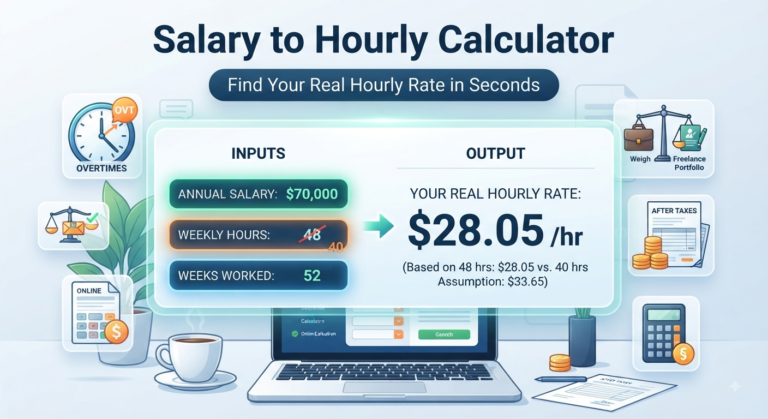
A $70,000 salary looks identical on paper whether you work 40 hours a week or 55. The total never changes, but the person working 55 hours earns meaningfully less per hour, and nothing on the pay stub shows it. Take a $70,000 salary in a role that is officially 40 hours but realistically runs closer to 48:
- At 40 hours a week, 52 weeks: $70,000 ÷ 2,080 = $33.65 an hour
- At 48 hours a week, 52 weeks: $70,000 ÷ 2,496 = $28.04 an hour
That is a difference of about $5.61 an hour, roughly a 17% hidden pay cut inside a salary that never changed on paper. Here is how real weekly hours change the rate at four common salaries:
| Annual salary | 40 hrs/week | 45 hrs/week | 50 hrs/week |
|---|---|---|---|
| $50,000 | $24.04/hr | $21.37/hr | $19.23/hr |
| $70,000 | $33.65/hr | $29.91/hr | $26.92/hr |
| $90,000 | $43.27/hr | $38.46/hr | $34.62/hr |
| $120,000 | $57.69/hr | $51.28/hr | $46.15/hr |
These assume 52 paid weeks a year.
When You Actually Need Your Hourly Rate
- Evaluating unpaid overtime: If your hours crept up without a matching raise, your hourly rate shows what that is costing you. Overtime rules under the Fair Labor Standards Act generally apply to non-exempt hourly workers, not salaried exempt employees, so many salaried staff receive no overtime premium.
- Comparing to freelance or contract work: Freelancers quote hourly rates, salaried employees do not. Convert your salary first, then use our freelance rate calculator to compare fairly.
- Deciding whether outsourcing makes sense: Whether to pay someone to handle a chore or task usually comes down to comparing your own hourly value with the service cost.
- Sanity-checking a raise: A 5% raise means something different per hour if your weekly hours also increased. Pair this tool with our raise calculator.
Common Mistakes People Make With This Conversion
- Always defaulting to 40 hours: If your real schedule runs longer, the default hides your true earning rate.
- Forgetting unpaid leave: If you take unpaid time off, using a flat 52 weeks overstates your hourly rate.
- Comparing gross rates to freelance quotes directly: A freelance rate must cover self-employment taxes and benefits that a salaried role already includes. Check the freelance rate calculator before comparing the two.
Comparing Salaried Pay to Freelance or Contract Work
If you are weighing a move from salaried work to freelancing, your converted hourly rate is only a starting point, not your target charge rate. A salaried job usually includes health insurance, retirement contributions and paid time off. A freelance rate must cover all of these on its own, including the full self-employment tax (Social Security and Medicare) that freelancers pay in full, instead of splitting it with an employer.
Find your current hourly equivalent first, then use the freelance rate calculator to see what you would need to charge, and estimate the added tax with the self-employment tax calculator.
How Taxes Change Your Real Hourly Rate
Everything above is a gross hourly rate, before taxes. To see what an hour of work nets you after federal tax, FICA and estimated state tax, run your salary through the paycheck calculator, then divide the after-tax annual figure by your real annual hours. Our tax bracket calculator shows where your income falls. It is a more sobering number, but a more honest one for budgeting.
Frequently Asked Questions
How do I convert a salary to an hourly wage?
Divide your annual salary by 2,080 for a standard full-time year, or by (hours per week × weeks per year) if your schedule is different.
How much is $72,000 a year per hour?
About $34.62 an hour, based on 2,080 hours. $104,000 a year is exactly $50.00 an hour.
How do I convert a monthly salary to hourly?
Multiply the monthly amount by 12, then divide by 2,080. A $5,000 monthly salary is about $28.85 an hour.
Does this calculator include overtime pay?
No. It assumes your salary is spread evenly across the hours you enter. If part of your pay is overtime at a different rate, calculate that separately with our overtime calculator.
Should I use 40 hours even if I sometimes work less?
Use your typical average. If your hours genuinely vary, estimate a realistic weekly average across the year instead of your single busiest or slowest week.
Is this useful for part-time salaried roles?
Yes. Enter your actual average hours instead of 40; the formula works the same way for any schedule.
Why does my hourly rate seem lower than I expected?
Usually because it uses your real hours rather than a flat 40. As the examples show, a heavier workload lowers your effective rate even though the salary stays the same.
Find Your Hourly Rate in Seconds
Whether you are evaluating unpaid overtime, comparing a job offer with freelance work, or just curious what your time is worth, the free Salary to Hourly Calculator gives an instant answer with no sign-up. You can also browse all salary and paycheck calculators.
Sources
- U.S. Bureau of Labor Statistics: Current Population Survey
- U.S. Department of Labor: Fair Labor Standards Act
- IRS Topic 554: Self-Employment Tax