
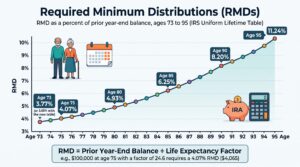
The RMD formula is simple: divide your account balance on December 31 of last year by the IRS life expectancy factor for your age. At 73 the factor is 26.5, so a $500,000 traditional IRA requires a withdrawal of $18,868 ($500,000 / 26.5). Miss it and the IRS can charge a 25% excise tax on the amount you failed to take.
This guide covers how to calculate your RMD with the formula, the factors by age, a worked example with the first-year timing trap, the penalty math and the legal ways to lower the tax bill. To run your own numbers, use our RMD calculator.
Last reviewed: October 11, 2026. For education only; not tax advice.
The RMD formula
RMD = account balance on December 31 of the prior year / distribution period for your age. The IRS says each RMD is based on the prior December 31 balance divided by a life expectancy factor from its tables. Most owners use the Uniform Lifetime Table in the regulations (26 CFR 1.401(a)(9)-9). A different table applies if your spouse is the sole beneficiary and is more than 10 years younger than you; it is Table II in IRS Publication 590-B.
RMD factors by age and what they mean in dollars
The RMD formula uses a factor that falls every year, so the share of your balance you must withdraw rises. Here is the Uniform Lifetime Table with the RMD on a $500,000 balance, assuming the balance on December 31 is the same each year:
| Age | Distribution period | % of balance | RMD on $500,000 |
|---|---|---|---|
| 73 | 26.5 | 3.77% | $18,868 |
| 75 | 24.6 | 4.07% | $20,325 |
| 80 | 20.2 | 4.95% | $24,752 |
| 85 | 16.0 | 6.25% | $31,250 |
| 90 | 12.2 | 8.20% | $40,984 |
| 95 | 8.9 | 11.24% | $56,180 |
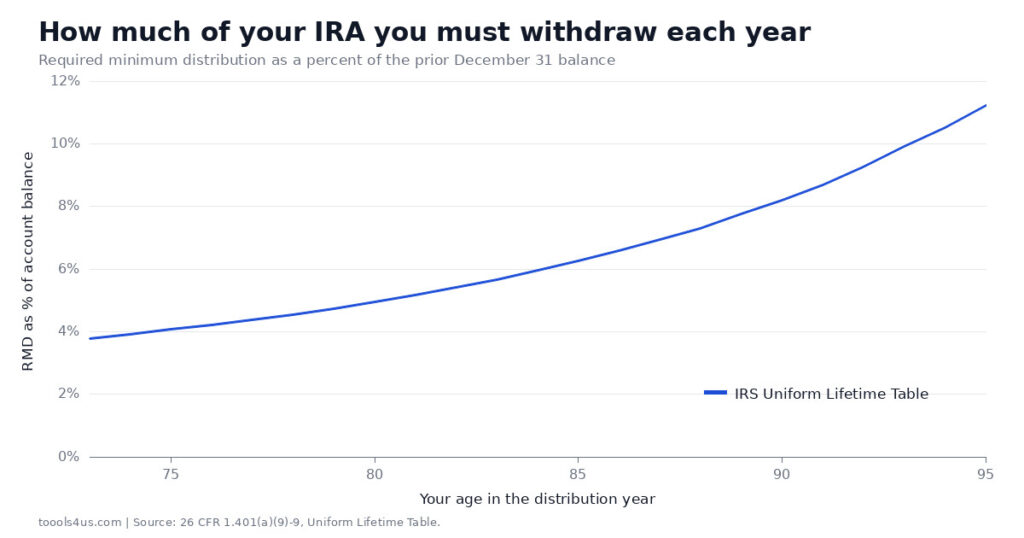
The table is a snapshot. Your real balance changes every year with markets and withdrawals, so recalculate each December with the new year-end balance. The RMD calculator lists the factor and the dollar amount for every age from 73 to 95.
When do RMDs start, and what is the deadline?
RMDs generally begin in the year you reach 73, according to the IRS. Under SECURE 2.0 the starting age is scheduled to rise to 75 in 2033, so check the current rule if you are younger. The deadlines are:
- First RMD: you may wait until April 1 of the following year. Reach 73 in 2026 and your first RMD is due by April 1, 2027.
- Every later RMD: due by December 31 of each year.
- Still working: in an employer plan such as a 401(k), the deadline is generally April 1 after the later of the year you reach 73 or the year you retire, if the plan allows it. This does not apply to IRAs, and the plan can set its own rules.
The first-year trap: two RMDs in one tax year
Delaying the first RMD to April 1 sounds helpful, but it stacks two taxable withdrawals into one year. Apply the RMD formula twice and you can see it. Example for someone who turns 73 in 2026, with $500,000 in a traditional IRA on December 31, 2025 and $520,000 on December 31, 2026:
| RMD | Calculation | Amount | Due |
|---|---|---|---|
| 2026 (age 73) | $500,000 / 26.5 | $18,868 | April 1, 2027 |
| 2027 (age 74) | $520,000 / 25.5 | $20,392 | December 31, 2027 |
| Taxable in 2027 | $39,260 |
Taking the first RMD in 2026 instead spreads the income over two tax years, which can keep you out of a higher bracket. Estimate the effect with the tax bracket calculator and the income tax calculator before you decide.
The penalty for missing an RMD
The IRS says a shortfall may be subject to an excise tax of 25%, or 10% if the RMD is timely corrected within two years. The tax may also be waived for reasonable error if you file Form 5329 with a letter of explanation. On the $18,868 RMD above, the penalty would be:
- 25%: $4,717
- 10% if corrected on time: $1,887
You still owe ordinary income tax on the withdrawal you should have taken. Getting the RMD formula wrong, for example by using the wrong year-end balance, can create the same shortfall, so check your inputs.
Which accounts have RMDs, and how to combine them
- Traditional IRA, SEP IRA, SIMPLE IRA, 401(k), 403(b), 457(b): yes.
- Roth IRA: no RMDs while the owner is alive. The IRS also exempts designated Roth accounts in employer plans. Beneficiaries of these accounts are subject to RMD rules.
- Several IRAs: calculate the RMD for each IRA separately, then withdraw the total from one or more of them.
- Several 401(k) or 457(b) plans: the IRS says RMDs must be taken separately from each plan account, so they cannot be combined.
If you are weighing a Roth account to avoid future RMDs, model it with the Roth IRA calculator and compare it with the traditional IRA calculator.
Legal ways to reduce the tax on an RMD
- Qualified charitable distribution (QCD). If you are 70½ or older, you can send money from an IRA directly to a charity. The 2026 limit is $111,000 per person, up from $108,000 in 2025, according to IRS Notice 2025-67. A QCD can count toward your RMD and is not included in taxable income.
- Take the first RMD in the year you turn 73. It avoids the double-RMD year shown above.
- Convert some money to a Roth before RMD age. Conversions are taxed in the year you do them, but a converted balance no longer counts toward future RMDs, because Roth IRAs have none during your life.
- Use the right table. If your spouse is the sole beneficiary and more than 10 years younger, you use Table II instead of the Uniform Lifetime Table, which generally gives a longer distribution period and a smaller RMD.
RMD questions
What are the new RMD rules for 2026?
The starting age is still 73, and the penalty is still 25%, or 10% if you fix the shortfall within two years (IRS). What is new for 2026 is the QCD limit of $111,000 per person (IRS Notice 2025-67). Some RMD regulations proposed in 2024 are not final yet: under IRS Announcement 2026-7 they will apply no earlier than 6 months after they are finalized, and until then you follow a reasonable, good-faith reading of the law, so ask your plan administrator how your plan applies them. Roth IRAs and designated Roth accounts still have no RMDs during the owner’s life.
What is the biggest RMD mistake to avoid?
Taking too little, or taking it too late. The shortfall is hit with a 25% excise tax on top of income tax on the withdrawal. Related errors are using the wrong December 31 balance, forgetting that 401(k) and 457(b) RMDs must be taken from each plan separately, and delaying the first RMD to April 1 without planning for the second one due in the same year.
What is the IRS RMD schedule?
Most owners use the IRS Uniform Lifetime Table: the factor is 26.5 at 73, 24.6 at 75, 20.2 at 80, 16.0 at 85 and 12.2 at 90 (see the table above). Your first RMD is due by April 1 after the year you turn 73, and every later one by December 31.
How much would the RMD be on $100,000?
If the prior year-end balance is $100,000, the RMD is $3,774 at 73 ($100,000 / 26.5), $4,065 at 75, $4,950 at 80, $6,250 at 85 and $8,197 at 90.
Do inherited IRAs follow the same RMD formula?
No. Most non-spouse beneficiaries of an owner who died after 2019 must empty the account within 10 years. Exceptions include a surviving spouse, a minor child of the owner, a disabled or chronically ill person, and someone not more than 10 years younger than the owner. Beneficiaries using a life expectancy payout use the IRS Single Life Expectancy Table, not the Uniform Lifetime Table.
How do I calculate my RMD for 2027?
Use your December 31, 2026 balance and the factor for the age you reach in 2027. At 74 the factor is 25.5, so a $520,000 balance gives $20,392.
Does the RMD formula work the same for a 401(k) and an IRA?
The formula is identical: prior year-end balance divided by your factor. The combining rules differ. Calculate the 401(k) RMD from that plan’s balance and the IRA RMD from your IRA balances, and take the 401(k) amount from the 401(k). Only IRAs can be combined with each other.
What is the RMD on $1,000,000 at 73?
$1,000,000 / 26.5 = $37,736. At $250,000 it is $9,434.
Is an RMD taxable?
Yes, as ordinary income if the money was pre-tax. A QCD is the main way to satisfy the RMD without adding to taxable income.
Do I need an RMD from a Roth IRA?
No. Roth IRAs have no RMDs during the owner’s life.
The takeaway
The RMD formula is last year-end balance divided by your IRS factor, and the dollar amount tends to rise as the factor shrinks. Calculate it each December, take the first one in the year you turn 73 if a double payout would push you into a higher bracket, and use a QCD if you give to charity. Run your balance through the RMD calculator and plan the rest of your income with the retirement calculator and the Social Security calculator.
Sources
- IRS: Retirement plan and IRA required minimum distributions FAQs
- IRS: Retirement topics, required minimum distributions
- 26 CFR 1.401(a)(9)-9: Uniform Lifetime Table
- IRS Notice 2025-67: 2026 limits, including the QCD limit
- IRS Publication 590-B: Distributions from IRAs
- IRS Announcement 2026-7: Applicability date for future RMD regulations