
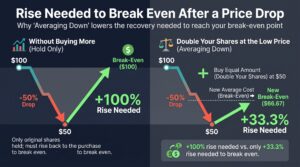
Averaging down means buying more shares of a stock you already own after the price has fallen, so your average cost per share drops. Own 200 shares at $40 and buy 200 more at $28, and your new average cost is $34. That lowers the price the stock must reach for you to break even, but it also raises the money you have riding on one position, here from $8,000 to $13,600.
This guide shows the averaging down formula, a worked example, how much the price has to recover, how many shares you need to hit a target average, and the tax rules that catch investors out. To test your own numbers, use our stock average calculator.
Last reviewed: October 11, 2026. For education only; this is not investment advice.
The averaging down formula
New average cost = (shares you own x your average cost + new shares x new price) / total shares. Commissions and fees belong in the cost. The IRS says the basis of stock you buy is the purchase price plus costs such as commissions, so a $10 commission on 100 shares adds $0.10 to your cost per share.
The same formula works in reverse for averaging up, where you buy more after the price has risen. With 100 shares at $50 and 100 more at $60, the new average is $55.
Averaging down example: 200 shares at $40, price now $28
You paid $8,000 for 200 shares. The stock has fallen 30% to $28, and you are deciding how much more to buy:
| New shares bought at $28 | Cash added | Total shares | New average cost | Rise from $28 to break even |
|---|---|---|---|---|
| None | $0 | 200 | $40.00 | 42.9% |
| 100 | $2,800 | 300 | $36.00 | 28.6% |
| 200 | $5,600 | 400 | $34.00 | 21.4% |
| 400 | $11,200 | 600 | $32.00 | 14.3% |
Buying 200 more shares cuts the recovery you need from 42.9% to 21.4%. The cost is that your total money in the stock goes from $8,000 to $13,600. If the price keeps falling, the extra shares lose money too.
Why a bigger drop needs a much bigger recovery
Break-even math is lopsided. A stock that falls 50% must rise 100% to recover. Averaging down softens that, but it never removes it:
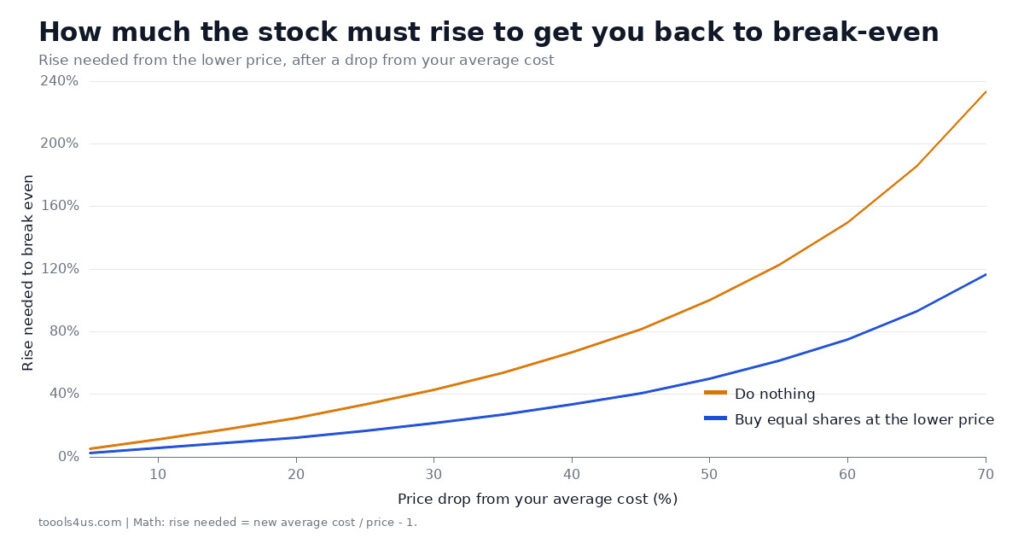
| Price drop from your cost | Rise needed if you do nothing | Rise needed after buying the same number of shares |
|---|---|---|
| 10% | 11.1% | 5.6% |
| 20% | 25.0% | 12.5% |
| 30% | 42.9% | 21.4% |
| 40% | 66.7% | 33.3% |
| 50% | 100.0% | 50.0% |
| 60% | 150.0% | 75.0% |
| 70% | 233.3% | 116.7% |
Even after doubling your shares, a stock down 70% must still rise 116.7% to get you even. Buying the same number of shares at the lower price cuts the required rise exactly in half, but after a deep drop the recovery you still need is large.
How many shares you need to reach a target average
Rearrange the formula to find the shares needed: shares to buy = shares owned x (current average – target average) / (target average – current price). In the example, to reach a $34 average you need 200 x ($40 – $34) / ($34 – $28) = 200 shares, costing $5,600. Check: ($8,000 + $5,600) / 400 = $34.
| Target average | Shares to buy at $28 | Cash needed |
|---|---|---|
| $36 | 100 | $2,800 |
| $34 | 200 | $5,600 |
| $32 | 400 | $11,200 |
The closer the target gets to the current price, the more cash it takes. You can never reach an average equal to the current price, because that would need an infinite number of shares.
When averaging down backfires
- The business changed. If the price fell because the company’s outlook got worse, a lower average cost does not make the position safer.
- The position gets too big. Each purchase adds to the same stock. In the example, one stock goes from $8,000 to $13,600 of your money.
- You are chasing a loss. Buying to feel better about your average, rather than because you would buy the stock today at $28, is the usual trap.
Averaging down is also not dollar-cost averaging. Dollar-cost averaging means investing a fixed amount on a schedule regardless of price. Averaging down is a one-off decision to add to a loser.
Taxes: your average cost is not always your tax cost
The calculator gives the average cost per share, which is the right figure for judging break-even. For taxes on individual stocks it can differ, because the IRS looks at lots.
- Which shares you sell. Under the Treasury regulations, if you do not adequately identify the shares sold, the stock sold is charged against the earliest lot you bought. The average basis method is for shares in a regulated investment company, such as a mutual fund, in certain accounts.
- Example. You hold 100 shares bought at $50 and 100 bought at $30, an average of $40. Selling 100 at $40 is a $1,000 loss if the earliest ($50) lot is used, a $1,000 gain if the $30 lot is identified, and zero on the average. Check how your broker reports it.
- The wash sale rule. If you sell at a loss and buy substantially identical stock within 30 days before or 30 days after the sale, the loss is generally not deductible. Averaging down right around a loss sale can trigger it.
- Long-term or short-term. The IRS treats a gain or loss as long-term if you held the asset for more than one year.
- Loss limits. A net capital loss reduces other income by up to $3,000 a year ($1,500 if married filing separately), and the rest carries forward.
Estimate the tax on a sale with the capital gains tax calculator, and see what a position pays you with the dividend calculator.
Five questions before you buy more
- Would I buy this stock today at $28 if I did not own it?
- Why did the price fall, and has the reason changed my view of the company?
- How much of my total savings would be in this one stock after the purchase?
- Could I live with this money losing another 30%?
- Am I within 30 days of selling any shares of it at a loss?
Averaging down questions
When does averaging down make sense?
When the reason you bought has not changed and you would buy the stock today at the lower price, using the five questions above. It makes the least sense when the price fell because the business got worse, or when the extra shares would make one stock a large part of your savings.
How is averaging down different from dollar-cost averaging?
Dollar-cost averaging invests a fixed amount on a schedule whatever the price. Averaging down is a one-off decision to buy more of a stock that has already fallen. Both lower your average cost when prices drop, but only dollar-cost averaging is automatic.
When does averaging down become a mistake?
When you are buying to lower your average rather than because the stock is worth owning, the trap sometimes called catching a falling knife. A drop of 30% needs a 42.9% rise to get back to even, and a lower average cost does not make the stock any more likely to recover.
How does averaging down affect diversification and risk?
It concentrates more money in one stock. In our example, 200 shares at $40 is $8,000; adding 200 more at $28 takes it to $13,600. The SEC’s Investor.gov explains diversification as spreading money across different investments to reduce risk, which is the opposite of adding to one position.
What should I check in the company before buying more?
Why the price fell and whether the company’s results, debt or outlook changed. Public companies file annual (10-K) and quarterly (10-Q) reports with the SEC, free on EDGAR, so you can read the reasons for yourself.
Is averaging down better for blue-chip stocks or speculative stocks?
The label matters less than the business. A large, established company can also decline for good reasons, while a speculative stock can lose most of its value. The riskier the stock, the smaller the position should be.
How much can I put into one falling stock?
There is no official limit. Set a maximum share of your portfolio before you buy, and stop when the purchase would take you past it. Use the stock average calculator to see the new total cost and share count first.
Is averaging down a good strategy?
It is a trade-off, not a rule. It lowers your break-even price, but it increases your exposure to a stock that has already fallen. It works best when the business is unchanged and the position stays a small part of your portfolio.
How do I calculate my average cost per share?
Divide the total you paid, including commissions, by the total number of shares. Or enter your shares and prices in the stock average calculator.
Does averaging down reduce the tax I owe?
Not by itself. Tax depends on the cost of the specific shares you sell, the holding period and the wash sale rule. A lower average cost matters for tax only when it matches the lots you actually sell.
Is averaging up the same formula?
Yes. The formula does not care whether the new price is lower or higher than your average cost.
The takeaway
Averaging down lowers your average cost, and the formula is simple: total money in, divided by total shares. A drop of 30% needs a 42.9% rise to get back to even, or 21.4% after you double your shares at the lower price. Decide with the five questions above, keep one stock from dominating your savings, and check the wash sale and lot rules before you sell. Run your own numbers in the stock average calculator and compare long-term growth with the investment calculator.
Sources
- IRS Topic 703: Basis of assets
- IRS Topic 409: Capital gains and losses
- 26 U.S.C. 1091: Loss from wash sales
- 26 CFR 1.1012-1: Basis of property, including stock identification and average basis
- IRS Publication 550: Investment income and expenses
- SEC Investor.gov: Asset allocation and diversification