
A $100,000 lump sum buys roughly $625 a month for life for a 65-year-old man and $590 a month for a 65-year-old woman at 2026 rates. Pick a fixed 20-year payout at 5% instead and the same money pays $659.96 a month, but the checks stop after 20 years. That gap is the whole story of an annuity payout: a fixed term pays more each month but stops, while a lifetime annuity pays less each month but never runs out.
Below are the real figures, the return you are actually buying, how the income is taxed, and what to check before you hand money to an insurer. To test your own amount, use our annuity payout calculator.
Last reviewed: October 11, 2026. For education only; not financial advice.
How much does a $100,000 annuity pay per month?
For a single-life immediate annuity (payments for as long as you live, nothing left for heirs), the monthly payout rises with age because the insurer expects to pay for fewer years. These are 2026 quotes for $100,000:
| Age when payments start | Man | Woman | Joint life (two people) |
|---|---|---|---|
| 60 | $565 | $535 | $485 |
| 65 | $625 | $590 | $530 |
| 70 | $710 | $665 | $595 |
| 75 | $830 | $770 | $685 |
Source: the 2026 single premium immediate annuity table published by MyAnnuityStore, an annuity broker, read on October 10, 2026. Real quotes change daily and differ by insurer and state, so treat the table as a guide and get written quotes before you decide.
Two patterns matter. Women receive slightly less than men of the same age because they live longer on average. And a joint-life annuity, which keeps paying a spouse after the first death, pays less than a single-life one, about $530 against $590 and $625 at 65.
Fixed-period payout or lifetime payout?
A fixed-period payout spreads the money over a set number of years at an interest rate. The monthly payment is the standard loan formula in reverse: payment = lump sum x r / (1 – (1 + r)^-n), where r is the monthly rate and n the number of months. This table uses that formula, the same one inside our calculator, for $100,000:
| Payout term | 3% rate | 4% rate | 5% rate | 6% rate |
|---|---|---|---|---|
| 10 years | $965.61 | $1,012.45 | $1,060.66 | $1,110.21 |
| 20 years | $554.60 | $605.98 | $659.96 | $716.43 |
| 30 years | $421.60 | $477.42 | $536.82 | $599.55 |
Payments scale with the amount, so $250,000 pays 2.5 times as much and $500,000 pays 5 times as much. A lifetime annuity at 65 pays $625, which is close to what a 5% fixed term of about 22 years would pay. The difference is that the lifetime check keeps coming if you reach 95, and a fixed term does not.
Annuity payout by amount: $50,000 to $2 million
Searchers often ask about larger or smaller lump sums. Because payments scale with the amount, you can estimate any size by multiplying the $100,000 figures above. This table does that for a 65-year-old buying a single-life annuity, next
to a 20-year fixed payout at 5%:
| Lump sum | Lifetime, man at 65 | Lifetime, woman at 65 | 20-year fixed at 5% |
|---|---|---|---|
| $50,000 | $312.50 | $295.00 | $329.98 |
| $150,000 | $937.50 | $885.00 | $989.93 |
| $200,000 | $1,250.00 | $1,180.00 | $1,319.91 |
| $250,000 | $1,562.50 | $1,475.00 | $1,649.89 |
| $300,000 | $1,875.00 | $1,770.00 | $1,979.87 |
| $400,000 | $2,500.00 | $2,360.00 | $2,639.82 |
| $500,000 | $3,125.00 | $2,950.00 | $3,299.78 |
| $1,000,000 | $6,250.00 | $5,900.00 | $6,599.56 |
| $2,000,000 | $12,500.00 | $11,800.00 | $13,199.11 |
The lifetime figures multiply the 2026 broker quotes in the first table, so they are estimates: real insurers can quote slightly different rates for different premium sizes, and every quote depends on age, state and product. The fixed-term figures come from the payment formula and are exact for the rate shown. Use the table to size your expectations, then get written quotes for your actual amount.
Two points about larger amounts. First, state guaranty protection is typically capped at about $250,000 in present value of annuity benefits, so a $1 million or $2 million purchase can exceed what a guaranty association would cover if the insurer failed; limits differ by state, so check yours. Second, a lifetime payout of $12,500 a month on $2 million is $150,000 a year, and if the buyer is alive at 95 that adds up to $4.5 million over 30 years, but if he dies at 75 it is far less.
What return are you really buying?
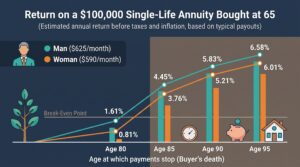
The sticker payout, $7,500 a year on $100,000, looks like 7.5%. It is not a 7.5% return, because part of every check is your own principal coming back. The honest question is: given how long I live, what yearly return did I earn? Here is the return for a man who buys $625 a month at 65, and for a woman who buys $590 a month:
| Payments stop at age | Man ($625 a month) | Woman ($590 a month) |
|---|---|---|
| 80 | 1.61% a year | 0.81% a year |
| 85 | 4.45% a year | 3.76% a year |
| 90 | 5.83% a year | 5.21% a year |
| 95 | 6.58% a year | 6.01% a year |
The break-even point is simple arithmetic. $100,000 divided by $7,500 a year is 13.3 years, so a man who buys at 65 has his money back at about age 78. A woman at $590 a month ($7,080 a year) is back at about 79. Live longer and the annuity pays you a growing return; die earlier and the insurer keeps the difference. That is exactly what insurance is.
Annuity or lump sum: a test you can run yourself
Ask how long a lump sum would fund the same $625 a month if you invested it yourself. At a 3% return it lasts 17.0 years, at 4% it lasts 19.1 years, and at 5% it lasts 22.0 years, which takes a 65-year-old to about 87. After that the lump sum is gone, while the annuity keeps paying. So the annuity wins if you live well past 87, and the lump sum wins if you die earlier or can earn clearly more than 5% after tax and fees.
Do not compare the $7,500 with the 4% rule, which would draw $4,000 a year from $100,000. The 4% rule leaves most of the principal in place for heirs and for later years; the annuity spends the principal. They answer different questions. Our retirement calculator guide explains how the 4% rule and withdrawal rates work.
Two costs to weigh. Most fixed payments do not rise with inflation, so $625 buys less each year. And the money is no longer yours to spend on an emergency. One common approach is to annuitize only the part of your savings needed to cover essential expenses beyond Social Security, and keep the rest invested. You can estimate your Social Security income with the Social Security calculator and compare it with the retirement calculator projection.
How an annuity payout is taxed
The tax depends on where the money came from.
- Bought with after-tax money (non-qualified). Each payment is part return of your own money, which is tax-free, and part earnings, which are taxable. The IRS General Rule in Publication 939 sets the tax-free share as your investment in the contract divided by the expected return. Once you have recovered your investment, every payment is fully taxable.
- Bought inside a pension, 401(k) or traditional IRA (qualified). The IRS generally uses its Simplified Method for these plans. If you never paid tax on the money going in, the whole payment is taxable income.
Worked example: a 70-year-old man (the $710 figure in the table above) buys a $100,000 non-qualified annuity paying $710 a month, or $8,520 a year. IRS Table V gives a multiple of 16.0 at age 70, the figure Publication 939 uses in its own example, so the expected return is $8,520 x 16.0 = $136,320. The exclusion ratio is $100,000 / $136,320 = 73.4%. Each year, $6,250 is tax-free and $2,270 is taxable. After 16 years, when the full $100,000 has come back, the entire $8,520 becomes taxable.
Withdrawing early from a deferred annuity can also trigger a 10% federal tax penalty before age 59½, according to the SEC. If your money is in a traditional IRA, remember that required withdrawals still apply to the rest of your balance; check yours with the RMD calculator.
Before you buy: what to check
The SEC’s investor education site lists the questions to ask any seller. These are the ones that change the decision most:
- Which type am I buying? An immediate annuity starts paying within a year. A deferred annuity grows first. Deferred types run, in rising order of risk, from fixed to fixed indexed to registered index-linked to variable, and the last two can lose money.
- What are all the fees? Ask for upfront, surrender, ongoing and implicit costs in writing.
- How long is the surrender period? A withdrawal inside it triggers a charge that reduces your value and return. The charge usually shrinks over time.
- How strong is the insurer? Your payments are only as good as the company paying them.
- What happens when I die? Check the death benefit and what your beneficiaries receive. A period-certain or refund feature lowers the monthly check.
On insurer failure, state guaranty associations usually protect up to $250,000 in present value of annuity benefits, based on the NAIC model act, although limits differ by state. The National Organization of Life and Health Insurance Guaranty Associations explains this on its product coverage FAQ, and you should confirm your state’s limit. If you are told to swap an existing annuity for a new one, be careful: the SEC warns that sellers can have incentives to push exchanges, and an exchange can start a new surrender period.
Annuity payout questions
How much does a $1,000,000 annuity pay per month?
At 2026 rates, a 65-year-old man buying a single-life lifetime annuity gets about $6,250 a month ($625 x 10), and a woman about $5,900. A 20-year fixed payout at 5% pays about $6,599.56 a month. Real quotes vary by insurer, age and state.
How much does a $300,000 immediate annuity pay per month?
About $1,875 a month for a 65-year-old man and $1,770 for a woman on a lifetime payout. A 20-year fixed payout at 5% pays about $1,979.87 a month. An immediate annuity is one that starts paying within a year, which is what the tables above show.
How much will a $2 million annuity pay me over 30 years?
It depends on the type. A 30-year fixed payout at 5% pays about $10,736.43 a month, which totals about $3.87 million over the 360 payments. A lifetime payout for a 65-year-old man is about $12,500 a month, or $4.5 million over 30 years if he lives to 95 but less if he does not.
How much will a $500,000 annuity pay per month?
Payments scale with the lump sum, so $500,000 pays five times the $100,000 figure: about $3,125 a month for a 65-year-old man ($625 x 5) and $2,950 for a woman. A 20-year fixed payout at 5% pays about $3,299.78 a month.
How much income can I expect from a $50,000 annuity?
About $312.50 a month for a 65-year-old man and $295 for a woman on a lifetime payout, or $329.98 a month for 20 years at a 5% fixed rate.
How much monthly income will $100,000 generate?
For a lifetime payout, about $625 a month for a 65-year-old man and $590 for a woman, and more if payments start later. A fixed payout depends on the term and rate: see the tables above.
How much does a $100,000 annuity pay in 10 years?
A 10-year fixed payout pays $965.61 a month at 3%, $1,012.45 at 4%, $1,060.66 at 5% or $1,110.21 at 6%. At 5% that adds up to about $127,279 over 120 payments, which is your $100,000 plus interest.
Is an annuity payout guaranteed?
It is guaranteed by the insurer’s ability to pay, backed up by state guaranty associations, which typically cover up to $250,000 in present value of annuity benefits. That is why the insurer’s financial strength matters as much as the payout rate.
What is the best age to start an annuity payout?
The payout rate rises with age, from $625 at 65 to $830 at 75 per $100,000 for a man. Waiting gives a bigger check but fewer years of it, so the better age depends on your health, other income and how much guaranteed income you need.
Can I get my money back after buying?
Not from an immediate annuity, where you swap the lump sum for income. A deferred annuity allows withdrawals but may charge a surrender fee and a tax penalty before 59½. Ask whether the contract has a free-look period and how long it lasts, and get the answer in writing before you sign.
The takeaway
A lifetime annuity payout is insurance against living a long time. At 65 it turns $100,000 into about $625 a month, breaks even near age 78 and returns 4% to 6% a year if you reach your late 80s or 90s. Run your own amount through the annuity calculator, compare at least three written quotes, and keep money you may need for emergencies outside the contract.
Sources
- SEC Investor.gov: Annuities
- IRS Publication 939: General Rule for Pensions and Annuities
- NOLHGA: Product coverage FAQ
- MyAnnuityStore: 2026 payout table