
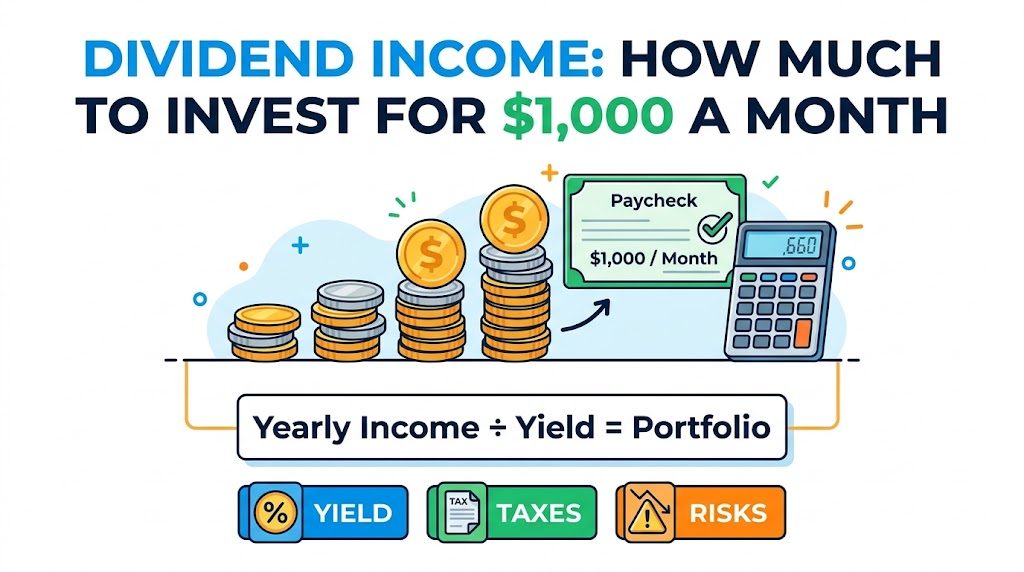
To earn $1,000 a month in dividend income, you need about $300,000 invested at a 4% dividend yield, or $400,000 at 3%. The math is one division: your yearly income goal divided by the yield. That is before tax, and a high yield can be a warning sign rather than a bargain.
This guide shows how much you need for $100 to $5,000 a month, how the yield is calculated, how reinvesting changes the result over 30 years, and how 2026 federal tax rules treat dividends. To test your own numbers, use our dividend calculator.
Last reviewed: October 11, 2026. For education only; this is not investment advice.
The dividend yield formula
Dividend yield = annual dividend per share / share price. A stock paying $2.00 a year in dividends at a price of $50 has a 4% yield ($2 / $50). The yield changes whenever the price changes, even if the dividend stays the same: at $40 the same $2 dividend is a 5% yield.
To turn an income goal into a portfolio size, rearrange it: money to invest = yearly dividend income / yield. For $1,000 a month, that is $12,000 a year. At a 4% yield, $12,000 / 0.04 = $300,000. In share terms, $12,000 / $2 per share is 6,000 shares, and 6,000 shares at $50 cost $300,000.
How much to invest for dividend income each month
This table shows the pre-tax portfolio needed at common yields:
| Monthly dividend income | At 2% yield | At 3% yield | At 4% yield | At 5% yield |
|---|---|---|---|---|
| $100 | $60,000 | $40,000 | $30,000 | $24,000 |
| $500 | $300,000 | $200,000 | $150,000 | $120,000 |
| $1,000 | $600,000 | $400,000 | $300,000 | $240,000 |
| $2,000 | $1,200,000 | $800,000 | $600,000 | $480,000 |
| $5,000 | $3,000,000 | $2,000,000 | $1,500,000 | $1,200,000 |
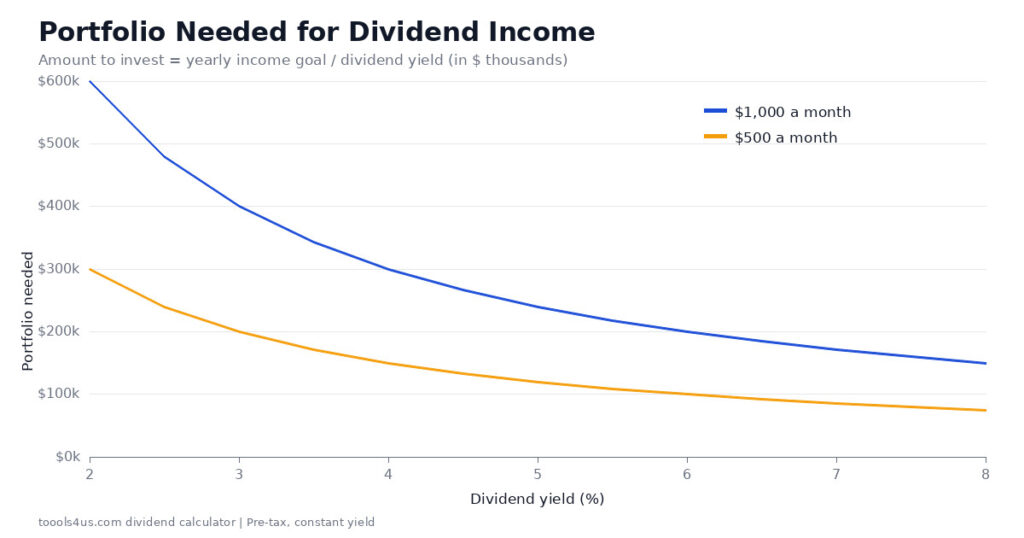
The curve is steep at the low end. Moving from a 4% to a 2% yield adds $300,000 to the $1,000-a-month goal, while moving from 4% to 6% saves only $100,000. That is why chasing a higher yield is tempting, and why it needs care.
Reinvest the dividends or take the cash?
If you do not need the income yet, reinvesting buys more shares, which pay more dividends next year. Using the same method as the calculator, assume $10,000 invested, a 3% dividend yield and 6% annual price growth:
| Years held | Value with dividends reinvested | Value if dividends taken as cash | Dividend income in the final year (reinvested) |
|---|---|---|---|
| 10 years | $23,674 | $17,908 | $652 |
| 20 years | $56,044 | $32,071 | $1,542 |
| 30 years | $132,677 | $57,435 | $3,652 |
With reinvestment the portfolio grows about 9% a year (3% + 6%), without it only the 6% price growth compounds. The cash you take is not lost, since you can spend or invest it elsewhere, but it stops compounding in this account. These are projections at a constant yield and growth rate, not predictions: real prices and dividends move every year. For other growth rates, try the investment calculator.
How dividend income is taxed in 2026
The IRS treats all taxable dividends as ordinary income, but qualified dividends are taxed at the lower long-term capital gain rates of 0%, 15% or 20%, depending on your taxable income. Your broker reports the total on Form 1099-DIV box 1a and the qualified part in box 1b. Reinvested dividends are included in box 1a, so reinvesting does not avoid the tax.
For 2026, the IRS sets these taxable-income limits (Rev. Proc. 2025-32):
| Filing status | 0% rate up to | 15% rate up to | 20% rate above |
|---|---|---|---|
| Single | $49,450 | $545,500 | $545,500 |
| Married filing jointly | $98,900 | $613,700 | $613,700 |
| Head of household | $66,200 | $579,600 | $579,600 |
| Married filing separately | $49,450 | $306,850 | $306,850 |
The holding period. To count as qualified, you generally must hold common stock for more than 60 days during the 121-day period that starts 60 days before the ex-dividend date. Dividends you do not hold long enough are taxed as ordinary income.
Example. A single filer earns $60,000 in wages and receives $12,000 of qualified dividends (the $1,000-a-month goal). The 2026 standard deduction for a single filer is $16,100, so taxable income before dividends is $60,000 – $16,100 = $43,900. That leaves $49,450 – $43,900 = $5,550 of the 0% zone. So $5,550 of the dividends are taxed at 0% and the remaining $6,450 at 15%, which is $967.50 of federal tax on the dividends. State tax is separate. A single filer with no other income and $12,000 of qualified dividends has taxable income below zero after the standard deduction, so owes no federal income tax on them.
The 3.8% surtax. Dividends count as net investment income. The 3.8% net investment income tax applies to the lesser of your net investment income or the amount your modified adjusted gross income exceeds $200,000 (single or head of household), $250,000 (married filing jointly) or $125,000 (married filing separately).
Accounts matter. Dividends received inside a traditional IRA or 401(k) are not taxed each year; tax comes when you withdraw, and you must start required withdrawals later in life (see our RMD formula guide). To see how selling shares is taxed, use the capital gains tax calculator.
The risks that cost dividend investors money
- The yield trap. Yield rises when the price falls. A 9% yield may mean the market expects the dividend to be cut, so check earnings and the company’s dividend history, not only the number.
- Dividends are not guaranteed. A company’s board decides each payment and can reduce or stop it.
- Concentration. Putting $300,000 into a few high-yield stocks ties your income to a few businesses. If one cuts its payout, a large part of your income goes with it.
- The price can fall. Dividend income does not protect your principal. If a stock drops 30%, the dividend you receive may not make up for it. If you buy more after a drop, read our guide to averaging down a stock first.
- Tax drag. In a taxable account the dividends are taxed each year even if you reinvest them, which the pre-tax table above does not show.
How to check if a dividend is safe
A high yield only helps if the company can keep paying it. Three checks take a few minutes:
- Payout ratio = annual dividend per share / earnings per share. A company paying $2.00 a share and earning $4.00 pays out 50% of its profit. If it earns only $1.80, the ratio is 111%: it pays more than it earns, which is hard to sustain.
- Dividend history. Look for years of steady or rising payments, and for past cuts. A company’s investor relations page lists them.
- Debt and cash flow. The annual report (Form 10-K) on the SEC’s EDGAR shows whether the company has the cash to pay and how much it owes.
None of these guarantees the dividend, but a high yield with a payout ratio above 100% is a reason to look closer before you invest.
Five questions before you build a dividend portfolio
- What yearly income do I need, and what portfolio does that need at a realistic yield?
- Is this a taxable account, an IRA or a Roth IRA?
- Why is this stock’s yield higher than similar companies, and can it pay the dividend from earnings?
- How much of my savings would sit in any one company?
- Do I need the cash now, or can I reinvest for 10 to 30 years?
Dividend income questions
What is US dividend income?
It is the money US companies pay shareholders out of profits, taxable in the year you receive it, including dividends you reinvest. The IRS treats all taxable dividends as ordinary income, and the part that meets the holding-period rules is called qualified and taxed at lower rates.
How much tax on dividend income in the USA?
Qualified dividends are taxed at 0%, 15% or 20% in 2026, depending on taxable income (limits in the table above). Other dividends are taxed at ordinary rates of 10% to 37%. High earners may also owe the 3.8% net investment income tax, and many states add their own tax.
How do I calculate my dividend income?
Multiply the number of shares by the annual dividend per share, or multiply the amount invested by the yield. 1,000 shares paying $2.00 a year earn $2,000 a year, or about $167 a month. $300,000 at 4% earns $12,000 a year.
How much tax do I pay on $50,000 of dividends?
It depends on your other income and on whether the dividends are qualified. For a single filer with $60,000 of wages and the 2026 standard deduction, $50,000 of qualified dividends costs $6,667.50 in federal tax: $5,550 falls in the 0% zone and $44,450 is taxed at 15%. If the same $50,000 were ordinary dividends, the tax would be $10,350. A married couple filing jointly with $120,000 of wages would pay $5,835 on qualified dividends. With no other income, a single filer owes no federal income tax on $50,000 of qualified dividends, because taxable income after the standard deduction is $33,900.
What makes a dividend qualified?
It must generally come from a US company or qualified foreign corporation, and you must hold the stock for more than 60 days during the 121-day period that begins 60 days before the ex-dividend date. Your broker shows the qualified part in box 1b of Form 1099-DIV.
Do ETFs pay qualified dividends?
Some of their dividends can be. Funds report the qualified portion in box 1b of Form 1099-DIV, so the share varies by fund and year. Check the form rather than assuming.
What is the US dividend tax for foreigners?
US-source dividends paid to a nonresident alien are generally subject to 30% withholding, unless a tax treaty lowers the rate. The recipient claims the treaty rate with Form W-8BEN. The rate depends on your country, so check the treaty.
How do I calculate a dividend yield?
Divide the annual dividend per share by the share price. A $2.00 dividend on a $50 stock is a 4% yield. Dividing the portfolio income by the amount invested gives the same result.
What does a 4%, 5% or 7% dividend yield mean?
It is the yearly dividend as a percentage of the price: $4, $5 or $7 a year for every $100 of stock, or $4,000, $5,000 or $7,000 on $100,000. A 7% yield is not automatically better. It can mean the price has fallen or the market expects a cut, so check earnings and the payout history.
Is a higher dividend yield better?
Not necessarily. Yield rises when the price falls, and a company’s board can reduce or stop the dividend. Compare yields only between similar companies, and check whether earnings cover the payout.
Which stocks pay dividends monthly?
Many US companies pay quarterly and some pay monthly, and the list changes. Paying monthly does not raise your yearly income: a 4% yield pays the same $12,000 a year on $300,000 whether it comes in 12 payments or 4. Check a company’s dividend history in its investor relations page or SEC filings before relying on it.
How much dividend income per month can I earn?
Monthly income is the portfolio times the yield, divided by 12. $300,000 at 4% is $1,000 a month; $600,000 at 4% is $2,000.
How can I earn $4,000 a month in dividends?
That is $48,000 a year, which takes about $1,200,000 at a 4% yield, $1,600,000 at 3% or $960,000 at 5%, before tax.
Is it possible to earn $5,000 a month in dividends?
Yes, with enough capital: $60,000 a year takes $1,500,000 at 4% or $1,200,000 at 5%, before tax. Dividends are not guaranteed, so the income can fall if companies cut their payouts.
How much do I need to invest to earn $1,000 a month in dividends?
Divide $12,000 by the yield. At 3% you need $400,000, at 4% $300,000, and at 5% $240,000, before tax.
How much do I need for $100 a month in dividend income?
$100 a month is $1,200 a year. At a 4% yield, that takes $30,000; at 3% it takes $40,000.
Are reinvested dividends taxed?
Yes in a taxable account. The IRS includes reinvested dividends in the total ordinary dividends reported on Form 1099-DIV, so you owe tax even though you received no cash.
What is a good dividend yield?
There is no single number. A yield only tells you income relative to price, so compare it with similar companies and check that the payout is covered by earnings. An unusually high yield deserves more checking, not less.
The takeaway
Dividend income comes down to one formula: yearly income goal divided by yield. A $1,000-a-month goal needs about $300,000 at 4%, $400,000 at 3% or $600,000 at 2%, before tax. Qualified dividends are taxed at 0%, 15% or 20% in 2026 depending on your taxable income, and a higher yield can mean higher risk. Run your own numbers in the dividend calculator, then compare it with other ways to build wealth using the investment calculator.
Sources
- IRS Rev. Proc. 2025-32: 2026 inflation adjustments
- IRS Topic 404: Dividends
- IRS Instructions for Form 1099-DIV
- IRS Topic 559: Net investment income tax
- IRS Publication 550: Investment income and expenses
- IRS: Withholding on US-source income paid to nonresident aliens