
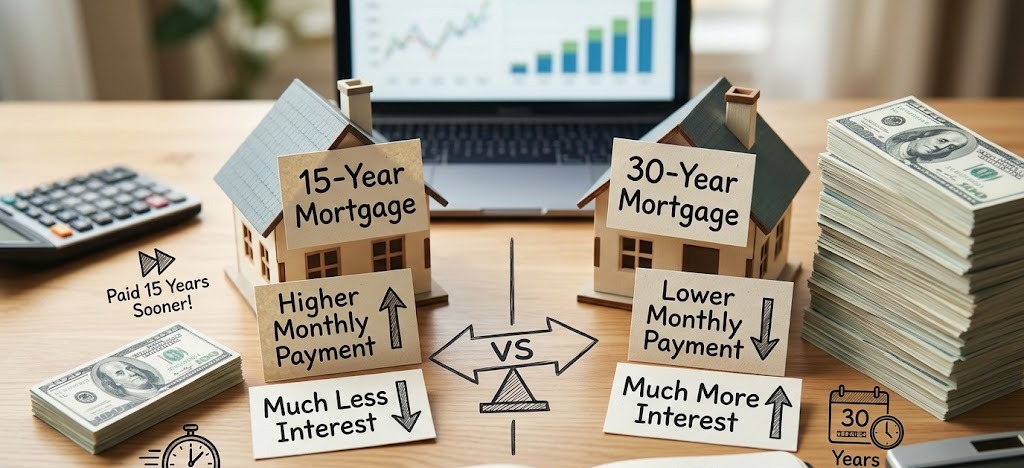
The 15 year vs 30 year mortgage choice is a trade between a bigger monthly payment and a much smaller interest bill. On a $300,000 loan at the national averages of October 8, 2026 (6.73% for 15 years, 7.40% for 30), the 15-year payment is $574 a month higher, but you pay $270,517 less interest and own the house outright 15 years sooner. In short: the 15-year loan costs less if its payment fits your budget comfortably, and the 30-year loan is safer if it does not.
This guide uses current rates, answers the questions buyers search most, and shows when each loan makes sense, including the option of taking a 30-year loan and paying extra. To run your own loan, use our mortgage calculator.
Last reviewed: October 11, 2026. For education only; this is not financial advice.
15 year vs 30 year mortgage rates today
In a 15 year vs 30 year mortgage comparison, the shorter loan carries the lower rate. Freddie Mac’s weekly Primary Mortgage Market Survey of October 8, 2026 reported:
| Loan | This week | Week ago | Year ago |
|---|---|---|---|
| 30-year fixed | 7.40% | 7.28% | 6.30% |
| 15-year fixed | 6.73% | 6.60% | 5.53% |
The gap is 0.67 percentage points. These are national averages, not a quote: your rate depends on your credit, down payment, loan size and lender, and it moves every week. Check the current figure on Freddie Mac and get written quotes before you decide.
15 year vs 30 year mortgage payment: the monthly difference
These are principal and interest only, using the rates above. Taxes, insurance and any mortgage insurance come on top.
| Loan amount | 15-year payment (6.73%) | 30-year payment (7.40%) | 15-year costs more per month | Total interest, 15-year | Total interest, 30-year | Interest saved by the 15-year |
|---|---|---|---|---|---|---|
| $100,000 | $883.80 | $692.38 | $191.42 | $59,084 | $149,257 | $90,173 |
| $200,000 | $1,767.60 | $1,384.76 | $382.84 | $118,168 | $298,513 | $180,345 |
| $300,000 | $2,651.40 | $2,077.14 | $574.26 | $177,253 | $447,770 | $270,517 |
| $400,000 | $3,535.20 | $2,769.52 | $765.68 | $236,337 | $597,027 | $360,690 |
The monthly payment on a 15-year mortgage for $100,000 is $883.80 at 6.73%. Part of the gap comes from the shorter term and part from the lower rate. If both loans had the same rate, the term alone would still matter. Here is the payment per $100,000 at the same rate:
| Interest rate | 15-year payment | 30-year payment |
|---|---|---|
| 5% | $790.79 | $536.82 |
| 6% | $843.86 | $599.55 |
| 7% | $898.83 | $665.30 |
For any loan size, multiply by the amount divided by $100,000. A $250,000 loan at 6% costs $2,109.65 a month over 15 years and $1,498.88 over 30.
Why a 30-year loan builds equity so slowly
In the early years almost all of a 30-year payment is interest. On the $300,000 loan above, the balance after five years is still $283,569 (you have repaid only $16,431), and after 15 years you still owe $225,448, or 75% of the loan. The 15-year loan is at $231,116 after five years and $134,766 after ten.
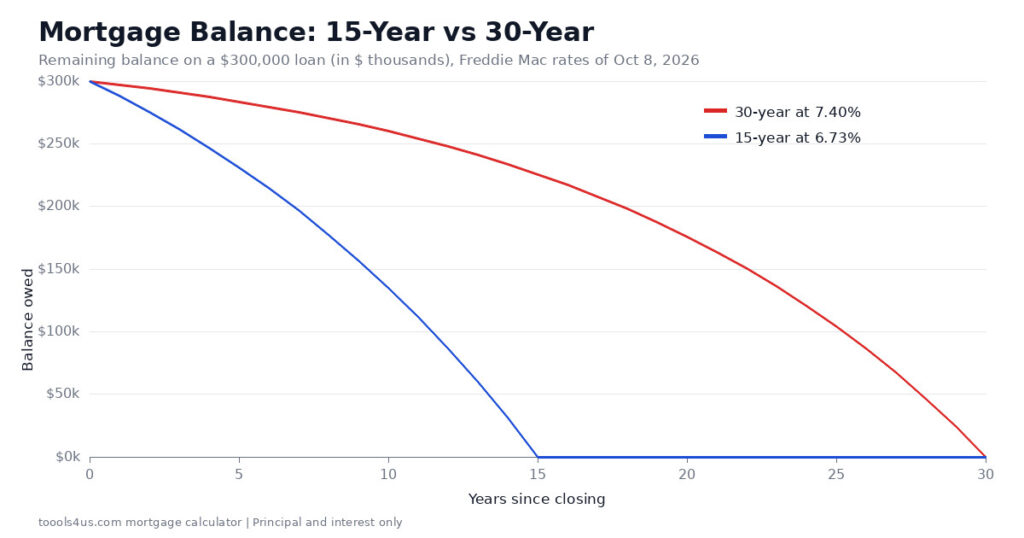
This matters if you may sell in the first 5 to 10 years: on a 30-year loan you will have repaid little principal, so what you take away from the sale depends more on the price the house sells for.
Pay extra on a 30-year mortgage or take a 15-year loan?
You can take the 30-year loan and choose to pay more. Using the same $300,000 loan at 7.40% (required payment $2,077.14):
| Option | Monthly payment | Paid off in | Total interest |
|---|---|---|---|
| 30-year, no extra | $2,077.14 | 30 years | $447,770 |
| 30-year + $200 extra a month | $2,277.14 | 22.7 years | $319,894 |
| 30-year + $500 extra a month | $2,577.14 | 17.2 years | $230,423 |
| 30-year + $574.26 extra (the 15-year payment) | $2,651.40 | 16.2 years | $216,021 |
| 15-year at 6.73% | $2,651.40 | 15 years | $177,253 |
Paying the same $2,651.40 a month on both loans, the 15-year loan still comes out about $38,768 ahead in interest, because its rate is 0.67 points lower. That is the price of keeping flexibility.
What the 30-year loan gives you is the choice. If your income drops or an emergency hits, you can go back to the required $2,077.14. With a 15-year loan, the higher payment is required every month. Before you rely on extra payments, check that your loan has no prepayment penalty and that extra money is applied to principal. To plan the payoff, try the debt payoff calculator.
The disadvantages of a 15-year mortgage
- A much higher required payment. $574 more a month on a $300,000 loan, or $6,891 a year, every year, no matter what your income does.
- Less cash left over. Money that goes to the mortgage cannot go to an emergency fund, retirement accounts or other debts. If you are not already saving for retirement, see our retirement calculator guide first.
- It can shrink the loan you qualify for. Lenders compare your monthly debts with your income, so a higher payment can reduce how much you can borrow.
- It ties up money in the house. Home equity is hard to turn back into cash. If you could earn a return on the extra $574 elsewhere, test it with the compound interest calculator, but remember that returns are not guaranteed and paying down a loan is a certain saving.
- A smaller interest deduction. The IRS lets you deduct home mortgage interest only if you itemize on Schedule A. For the 2026 tax year the standard deduction is $16,100 for a single filer and $32,200 for a married couple filing jointly, so many buyers get no tax benefit from mortgage interest either way. If you do itemize, interest on debt taken out after December 15, 2017 is deductible on up to $750,000 of loan ($375,000 if married filing separately).
The 30-year loan has its own costs: the higher rate, $270,517 more interest on the $300,000 example, and a balance that falls slowly. Neither loan is free; you are choosing which cost you would rather carry.
Why Dave Ramsey recommends a 15-year mortgage
Ramsey Solutions recommends a 15-year fixed-rate conventional mortgage, and says its preferred way to buy is with cash. Its reasoning, as it states it, is that the shorter loan costs far less in interest, builds equity faster and ends in half the time. Its example is a $320,000 loan at 6% over 15 years against 6.75% over 30 years, with total interest of $166,062 against $427,188.
Its guardrail matters as much as its recommendation: total housing costs, including principal, interest, property taxes, insurance, mortgage insurance and any HOA fees, should be no more than 25% of your take-home pay. If a 15-year payment breaks that limit, Ramsey says to look at cheaper homes or save a larger down payment, not switch to a 30-year loan.
Test it on our example. The $2,651.40 principal-and-interest payment alone needs about $10,606 of monthly take-home pay to stay within 25%, and taxes and insurance push that higher. The 30-year payment of $2,077.14 needs about $8,309. This is one person’s rule, not a law: it shows how a 15-year loan limits how much house you can afford, which is the point of the rule.
At what age do you pay off a mortgage?
There is no single age, because it depends on when you borrow and on what you do with the loan. Here is the arithmetic if you keep a loan to the end of its term:
| Age when you take the loan | Paid off at, 30-year term | Paid off at, 15-year term |
|---|---|---|
| 30 | 60 | 45 |
| 35 | 65 | 50 |
| 40 | 70 | 55 |
| 45 | 75 | 60 |
A buyer who takes a 30-year loan at 45 will still be paying at 75, which is a real problem if retirement income is lower. The reverse also holds: if you want to be mortgage-free by 65, the loan term and your age at purchase have to add up to 65, or you need to pay extra.
15 year vs 30 year mortgage: which is better for you?
Choose a 15-year loan if the payment fits comfortably inside your budget (for example within the 25% guideline above), you already have an emergency fund and retirement savings, your income is stable, and you want the lowest total cost and the fastest equity.
Choose a 30-year loan if the 15-year payment would stretch you, your income varies, you want room for other goals, or you would rather decide each month how much extra to pay. If you choose it, set up the extra payment on purpose, otherwise the extra interest is the cost of flexibility you never used.
Five questions to settle it:
- Can I pay the 15-year payment every month, even in a bad year?
- Is my emergency fund (and retirement saving) already on track?
- How long will I keep this house? In the first 5 to 10 years of a 30-year loan, the principal repaid is small.
- Will I really pay extra on a 30-year loan if I take it?
- Does my loan have a prepayment penalty?
15 year vs 30 year mortgage questions
Is it better to take out a 15 or 30-year mortgage?
A 15-year mortgage costs far less in total interest ($177,253 against $447,770 on a $300,000 loan at today’s averages) but needs a $574 higher monthly payment. It is better if you can afford the payment comfortably; a 30-year loan is better if you need flexibility.
What is the disadvantage of a 15-year mortgage?
The higher required payment. It reduces monthly cash flow, can lower the loan amount you qualify for, and cannot be reduced if your income drops.
What is the monthly payment for a 15-year mortgage on $100,000?
$883.80 a month at 6.73% (principal and interest), $843.86 at 6%, or $790.79 at 5%. Total interest at 6.73% is $59,084.
Why does Dave Ramsey recommend a 15-year mortgage?
Ramsey Solutions says it saves a lot of interest, builds equity faster and pays off the home in half the time. It pairs the advice with a limit: housing costs no more than 25% of take-home pay.
Is it better to pay extra on a 30-year mortgage or get a 15-year mortgage?
The 15-year loan costs less because its rate is lower: at the same $2,651.40 a month, it saves about $38,768 more interest than a 30-year loan with extra payments. The 30-year loan with extra payments wins on flexibility, since you can drop back to the lower required payment.
What is the difference in monthly payments between a 15-year and 30-year mortgage?
At today’s averages, $191 a month per $100,000 borrowed ($883.80 against $692.38). On $300,000 it is $574.
At what age do most people pay off a mortgage?
It depends on when you borrow. A 30-year loan taken at 35 ends at 65, and a 15-year loan at 35 ends at 50. Paying extra, refinancing or selling the home changes the date.
The takeaway
In the 15 year vs 30 year mortgage decision on a $300,000 loan, the shorter loan costs $574 more a month and saves $270,517 in interest, a trade that works only if the payment fits your budget. A 30-year loan with extra payments gets you part of the way, with the safety of a lower required payment. Compare your own numbers in the mortgage calculator, and compare your options for paying off other debts with the debt payoff calculator.
Sources
- Freddie Mac: Primary Mortgage Market Survey (rates as of October 8, 2026)
- Ramsey Solutions: 15-year vs. 30-year mortgage
- IRS Publication 936: Home mortgage interest deduction
- IRS Rev. Proc. 2025-32: 2026 standard deduction