
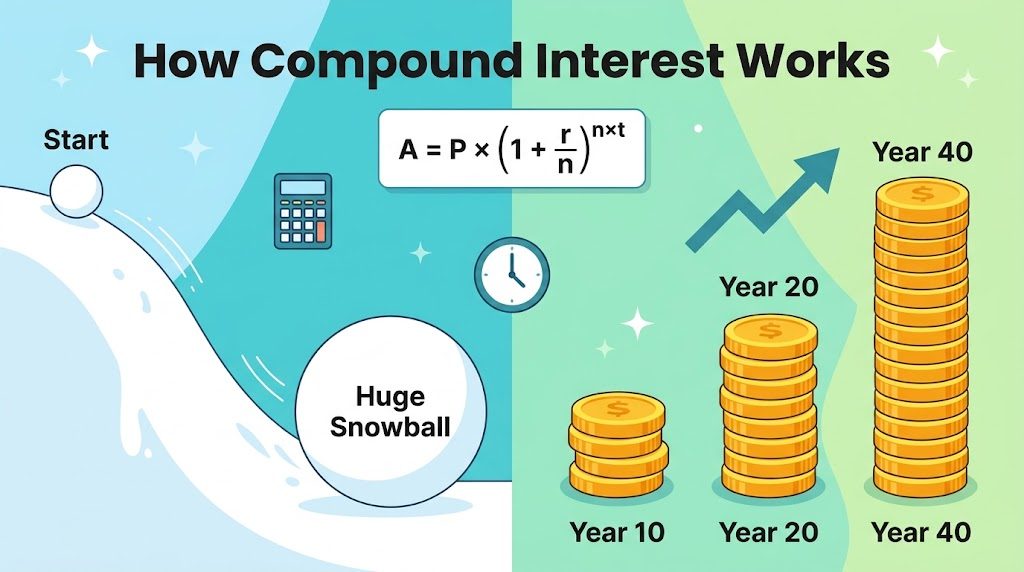
How compound interest works is simple to say and hard to feel: you earn interest on your original money and on the interest it has already earned. That is why $10,000 growing at 7% a year becomes $19,672 after 10 years, $76,123 after 30 and $149,745 after 40, while the same money earning only simple interest reaches just $38,000 after 40 years.
This guide covers the compound interest formula with worked examples, how much $10,000 grows over 10 years, how compounding frequency and APY change the result, and the ways compounding works against you when you borrow. To run your own numbers, use our compound interest calculator.
Last reviewed: October 11, 2026. For education only; this is not financial advice. All growth figures assume a constant rate with no taxes, fees or inflation.
What is compound interest? A simple definition
Simple interest is paid only on the amount you started with. $10,000 at 7% simple interest earns $700 every year, no matter how long you wait. Compound interest is paid on the amount you started with plus all the interest added so far, so each year’s interest is larger than the last. In finance, “compounding” means the moment interest is added to the balance and begins to earn interest itself.
The compound interest formula
A = P x (1 + r/n)^(n x t)
- A is the final amount.
- P is the principal, the money you start with.
- r is the annual interest rate as a decimal (7% = 0.07).
- n is how many times a year interest is compounded.
- t is the number of years.
When interest is compounded once a year, n = 1 and the compounded annually formula becomes A = P x (1 + r)^t. The interest earned is A – P.
Worked example: $15,000 at 15% for 5 years, compounded annually. A = 15,000 x (1.15)^5 = 15,000 x 2.01136 = $30,170.36. The interest earned is $15,170.36. If the same 15% were compounded monthly instead, n = 12 and the result would be 15,000 x (1 + 0.15/12)^60 = $31,607.72, which is $1,437 more.
How much is $10,000 in compound interest over 10 years?
It depends on the rate and how often interest is added:
| Annual rate | Compounded annually | Compounded monthly | Simple interest |
|---|---|---|---|
| 3% | $13,439.16 | $13,493.54 | $13,000 |
| 5% | $16,288.95 | $16,470.09 | $15,000 |
| 7% | $19,671.51 | $20,096.61 | $17,000 |
| 10% | $25,937.42 | $27,070.41 | $20,000 |
At 5% compounded annually, $10,000 becomes $16,288.95 in 10 years, which is $6,288.95 of interest. The higher the rate, the more compounding adds over simple interest: at 3% the gap is $439, at 10% it is $5,937.
Compounding frequency and APY
The more often interest is added, the more you earn, because new interest starts earning sooner. Here is $10,000 at a 5% rate for 10 years:
| Compounded | Value after 10 years | Effective yearly rate (APY) |
|---|---|---|
| Annually | $16,288.95 | 5.0000% |
| Semiannually | $16,386.16 | 5.0625% |
| Quarterly | $16,436.19 | 5.0945% |
| Monthly | $16,470.09 | 5.1162% |
| Daily | $16,486.65 | 5.1267% |
These are the common types of compound interest: annual, semiannual, quarterly, monthly and daily. There is also continuous compounding, a mathematical limit with the formula A = P x e^(rt), which gives $16,487.21 here. Going from annual to daily adds about $198 over 10 years, so the frequency matters far less than the rate and the time.
The annual percentage yield (APY) is the figure that lets you compare accounts. Under the federal Truth in Savings rules (Regulation DD), APY reflects both the interest rate and how often interest is compounded, and it shows the total interest an account earns over 365 days. Two accounts with the same rate can have different APYs, so compare APY, not the rate.
How compound interest works over time: why time matters most
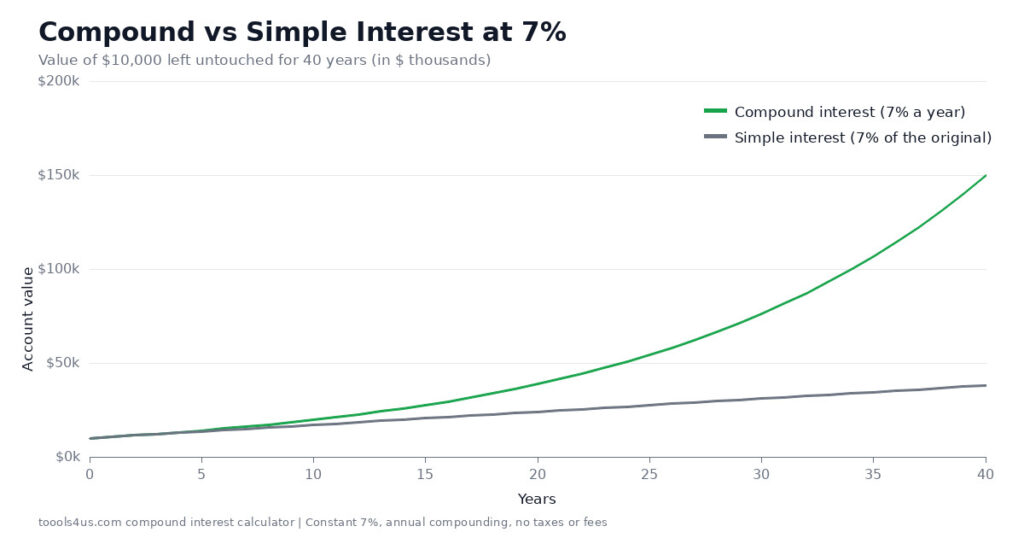
This is how compound interest works over time. For the first 10 years the two lines are close ($19,672 against $17,000). After that they pull apart, because the interest itself is now larger than the original deposit. At 40 years, compounding has produced almost four times as much as simple interest.
How compound interest works with monthly savings
Most people do not invest one lump sum; they add money every month. This table uses the same method as our calculator: 7% a year, compounded monthly, with each deposit made at the end of the month.
| Monthly contribution | After 10 years | After 20 years | After 30 years | After 40 years |
|---|---|---|---|---|
| $250 | $43,271 | $130,232 | $304,993 | $656,203 |
| $500 | $86,542 | $260,463 | $609,985 | $1,312,407 |
Compare two savers who each put in $120,000 in total: $250 a month for 40 years grows to $656,203, while $500 a month for 20 years grows to $260,463. Starting earlier, with the same total, produces more than 2.5 times as much. That is the answer to why compound interest is important: the number of years does more of the work than the size of the deposit.
The Rule of 72: how long compound interest takes to double your money
Divide 72 by the yearly rate to estimate the years needed to double. At 7%, 72 / 7 = about 10.3 years. The exact figure under monthly compounding is 9.9 years, so the shortcut is close:
| Annual return | Rule of 72 | Exact doubling time (monthly compounding) |
|---|---|---|
| 4% | 18.0 years | 17.4 years |
| 6% | 12.0 years | 11.6 years |
| 8% | 9.0 years | 8.7 years |
| 10% | 7.2 years | 7.0 years |
Where compound interest is used
- Savings accounts, money market accounts and CDs at banks and credit unions. Interest is added to your balance and then earns interest.
- Investments. Reinvested dividends and gains compound the same way. See how dividend income grows when reinvested, and project a portfolio with the investment calculator.
- Retirement accounts such as a 401(k) or IRA, where growth compounds for decades. Try the 401(k) calculator.
- Loans and credit cards, where compounding works against you.
Is compound interest good? When it works against you
How compound interest works depends on which side you are on: it is good when you are the saver and costly when you are the borrower. The Federal Reserve reported an average rate of 22.36% on credit card accounts assessed interest in August 2026 (preliminary). If you owe $5,000 at 22.36% and make no payments, monthly compounding makes it $6,240 after one year, so $1,240 of interest. Card issuers often compound daily, which would make it slightly more, $6,252. The same force that grows $10,000 to $149,745 makes unpaid debt grow fast.
So the best use of compounding is on both sides: earn it on savings and avoid paying it on high-rate debt. Our debt avalanche vs snowball guide shows how to pay down several debts, and the debt payoff calculator shows what each extra payment saves.
How to start earning compound interest
- Build a cash cushion first. Keep an emergency fund in a savings account, so you do not have to cash out investments in a bad month.
- Pick an account and compare APY. Nearly all banks and credit unions pay compound interest on savings accounts, money market accounts and CDs. Compare APYs, fees and minimums rather than just the headline rate.
- Check insurance. The FDIC insures deposits up to $250,000 per depositor, per insured bank, for each account ownership category.
- Set up automatic deposits. A fixed monthly deposit makes the table above happen without relying on willpower.
- Leave the interest in. Withdrawing it stops it from earning more interest.
Taxes. Interest from bank accounts, money market accounts and CDs is generally taxable in the year it is credited and available to you, even if you leave it in the account. Banks usually send Form 1099-INT if you were paid $10 or more, and you must report all interest income either way.
How compound interest works: questions
What is compound interest in simple terms?
Interest paid on both your original money and the interest already added. Simple interest is paid only on the original amount.
How is compound interest calculated?
With A = P x (1 + r/n)^(n x t), where P is the principal, r the yearly rate as a decimal, n the number of times a year interest is compounded and t the years. The interest is A – P.
How much is $10,000 in compound interest over 10 years?
At 5% compounded annually it grows to $16,288.95 ($6,288.95 of interest). At 7% it is $19,671.51 and at 10% it is $25,937.42, all compounded annually.
What is the amount of $15,000 compounded annually at 15% for 5 years?
$30,170.36, so $15,170.36 of interest. Compounded monthly it would be $31,607.72.
What banks offer compound interest?
Almost all banks and credit unions pay compound interest on savings accounts, money market accounts and CDs. Compare the APY, which already includes compounding, and check that the bank is FDIC-insured.
Where is compound interest used?
On savings, CDs and money market accounts, in investments with reinvested earnings, in retirement accounts, and in loans and credit cards, where it increases what you owe.
What are the types of compound interest?
They are named by how often interest is compounded: annually, semiannually, quarterly, monthly and daily. Continuous compounding is the mathematical limit.
Is compound interest good?
It is good on money you save or invest, and costly on money you owe. The time you leave money invested matters more than its size.
The takeaway
How compound interest works comes down to one formula and one lever: time. $10,000 at 7% reaches $19,672 in 10 years and $149,745 in 40, while saving $250 a month for 40 years reaches $656,203. Compare accounts by APY, start early, leave the interest in, and avoid paying compound interest on high-rate debt. Run your numbers in the compound interest calculator.
Sources
- CFPB: Regulation DD (12 CFR 1030.2), definition of annual percentage yield
- CFPB: Regulation DD Appendix A, APY calculation
- SEC Investor.gov: Compound interest calculator
- IRS Topic 403: Interest received
- FDIC: Deposit insurance
- Federal Reserve G.19: Consumer Credit