
Capital gains tax rates 2026 are the same three you already know, 0%, 15% and 20%, but the income thresholds moved up for inflation. A single filer now pays 0% on long-term gains up to $49,450 of taxable income, and 20% only above $545,500. On a $100,000 gain, a single filer with $60,000 of wages pays about $14,168 in federal tax; on $300,000, about $50,248 including the 3.8% net investment income tax.
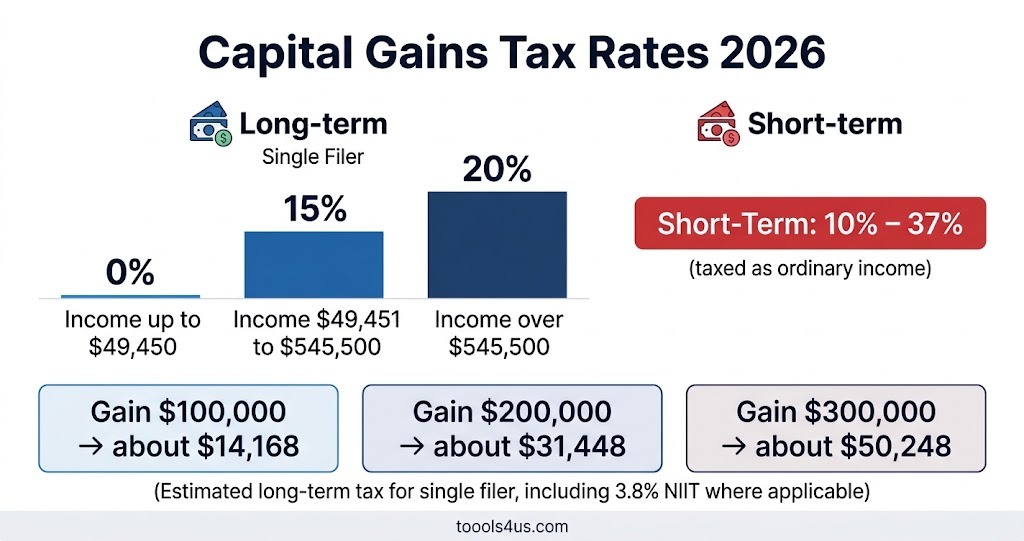
This guide covers the long-term capital gains tax rate 2026 and the short-term rate, the exact thresholds for each filing status, what you pay on a $100,000, $200,000 or $300,000 gain, and the extra taxes people miss. To run your own numbers, use our capital gains tax calculator.
Last reviewed: October 11, 2026. For education only; this is not tax advice. Figures are federal and use the 2026 inflation adjustments in IRS Rev. Proc. 2025-32.
What is the new capital gains tax for 2026?
There is no new capital gains tax for 2026. The rates did not change: 0%, 15% and 20% on long-term gains, and your ordinary income tax rate on short-term gains. What changed is the income thresholds where each long-term rate starts, which the IRS raises every year for inflation. A gain is long-term when you held the asset more than one year (IRS Topic 409).
Long-term capital gains tax rate 2026: 0%, 15% and 20% thresholds
The long-term capital gains tax rate 2026 in the USA depends on your taxable income, which includes the gain itself. The brackets below show where each rate applies in 2026, with 2025 for comparison.
| Filing status | 0% rate up to | 15% rate up to | 20% rate above |
|---|---|---|---|
| Single (2026) | $49,450 | $545,500 | $545,500 |
| Married filing jointly (2026) | $98,900 | $613,700 | $613,700 |
| Head of household (2026) | $66,200 | $579,600 | $579,600 |
| Married filing separately (2026) | $49,450 | $306,850 | $306,850 |
| Single (2025) | $48,350 | $533,400 | $533,400 |
| Married filing jointly (2025) | $96,700 | $600,050 | $600,050 |
Gains stack on top of your other income. A single filer with $30,000 of taxable wages and a $30,000 gain has $60,000 of taxable income: the first $19,450 of the gain falls under the 0% limit and the remaining $10,550 is taxed at 15%.
Who pays 20% on long-term capital gains?
Only taxpayers whose taxable income goes above $545,500 (single), $613,700 (married filing jointly), $579,600 (head of household) or $306,850 (married filing separately) in 2026. Only the part of the gain above that line is taxed at 20%. Most people never reach it.
Short-term capital gains tax rate 2026
Gains on assets held one year or less are short-term and taxed as ordinary income, at 10% to 37%. Because they are added to your wages, a large short-term gain can push you into a higher bracket. These are the 2026 ordinary brackets by taxable income, after the standard deduction ($16,100 single, $32,200 married filing jointly, $24,150 head of household).
| Rate | Single, taxable income over | Married filing jointly, over | Head of household, over |
|---|---|---|---|
| 10% | $0 | $0 | $0 |
| 12% | $12,400 | $24,800 | $17,700 |
| 22% | $50,400 | $100,800 | $67,450 |
| 24% | $105,700 | $211,400 | $105,700 |
| 32% | $201,775 | $403,550 | $201,750 |
| 35% | $256,225 | $512,450 | $256,200 |
| 37% | $640,600 | $768,700 | $640,600 |
For a quick look at your bracket, see our tax bracket calculator.
How much capital gains tax will I pay on $100,000, $200,000 or $300,000?
It depends on your other income and how long you held the asset. The examples below assume a single filer with $60,000 of wages, the 2026 standard deduction, and the gain as the only investment income. They are federal only; state tax is extra.
| Gain | Long-term federal tax | 3.8% NIIT | Total long-term | Effective rate |
|---|---|---|---|---|
| $100,000 | $14,167.50 | $0 | $14,167.50 | 14.17% |
| $200,000 | $29,167.50 | $2,280 | $31,447.50 | 15.72% |
| $300,000 | $44,167.50 | $6,080 | $50,247.50 | 16.75% |
If the same gains were short-term, the tax would be $22,114 on $100,000, $51,764 on $200,000 and $90,194.25 on $300,000 including the NIIT. Holding the asset past one year would save about $7,946, $20,317 and $39,947.
Married couple example
For a married couple filing jointly with $120,000 of wages, the 2026 totals are lower because the 0% and 15% ranges are wider.
| Gain | Long-term tax incl. NIIT | Short-term tax incl. NIIT |
|---|---|---|
| $100,000 | $13,335 | $20,700 |
| $200,000 | $30,995 | $46,888 |
| $300,000 | $49,795 | $74,688 |
So how much capital gains will you pay on $100,000? Roughly $13,000 to $14,000 long-term, or $20,000 to $22,000 short-term, for these two profiles. On $200,000 it is about $31,000, and on $300,000 about $50,000, long-term. Change the income and the answer changes, so run your own case in the capital gains tax calculator.
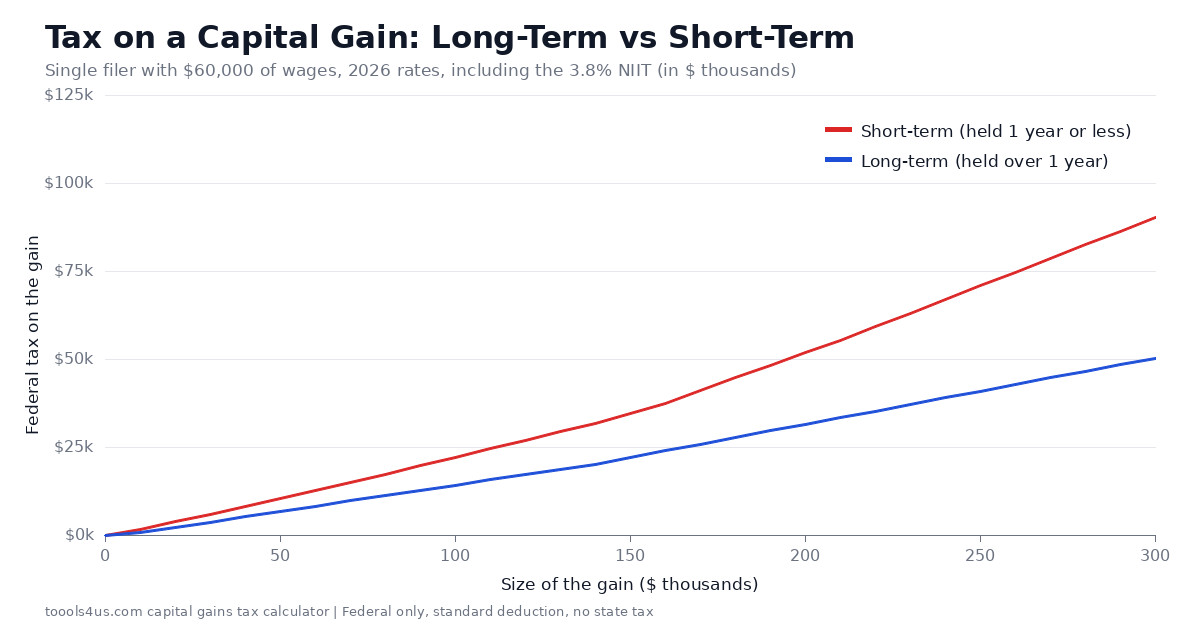
Capital gains tax rates 2026: long-term vs short-term
The chart shows the federal tax on gains from $0 to $300,000 for the same single filer. The gap widens as the gain grows, because short-term gains climb through the 24%, 32% and 35% brackets while long-term gains stay at 15% until the NIIT applies.
Other taxes and rules that change the bill
- Net investment income tax (NIIT): 3.8% on the lesser of your net investment income or the amount your modified AGI exceeds $200,000 (single), $250,000 (married filing jointly) or $125,000 (married filing separately) (IRS Topic 559).
- Special rates: collectibles such as art and coins are taxed up to 28%, unrecaptured Section 1250 gain on real estate up to 25%, and qualified small business stock gains up to 28% (IRS Topic 409).
- Home sales: you can exclude up to $250,000 of gain ($500,000 married filing jointly) if you owned and lived in the home at least two of the last five years (IRS Topic 701).
- Losses: capital losses offset gains, and up to $3,000 a year ($1,500 if married filing separately) can offset other income, with the rest carried forward (IRS Topic 409).
- State tax: many states tax capital gains too; check your state rules.
Ways to lower your tax under the 2026 capital gains rates
- Hold past one year. The long-term capital gains tax rate 2026 is 0%, 15% or 20%, while a short-term gain is taxed at ordinary rates of up to 37%.
- Offset gains with losses. Selling losers in the same year reduces taxable gains. Our guides on averaging down and dividend income help you track cost basis and income.
- Manage your taxable income. Lower income in a sale year can leave more of the gain in the 0% or 15% range. Estimate it with the income tax calculator.
- Use the home sale exclusion if you qualify.
Frequently asked questions
What is the new capital gains tax for 2026?
There is no new tax. Capital gains tax rates 2026 remain 0%, 15% and 20%, with thresholds raised for inflation. Short-term gains are taxed at ordinary rates of 10% to 37%.
How much capital gains will I pay on $100,000?
For a single filer with $60,000 of wages, long-term federal tax is $14,167.50, or 14.17%. Short-term it is $22,114. Other income, filing status and state tax change the result.
How much capital gains will I pay on $300,000?
For the same single filer, long-term federal tax is $44,167.50 plus $6,080 of NIIT, $50,247.50 in total. Short-term, with NIIT, it is $90,194.25.
How much capital gains will I pay on $200,000?
For the same single filer, long-term federal tax is $29,167.50 plus $2,280 of NIIT, $31,447.50 in total. Short-term, with NIIT, it is $51,764.
What are the long-term capital gains tax rates for 2026?
0%, 15% and 20%. For a single filer, 0% applies up to $49,450 of taxable income, 15% up to $545,500, and 20% above that.
How much is long-term capital gains tax in the USA?
Federally it is 0%, 15% or 20% depending on taxable income, plus the 3.8% NIIT for higher earners and any state tax. Collectibles and some real estate gains have higher special rates.
Who pays 20% long-term capital gains?
Taxpayers with taxable income above $545,500 (single) or $613,700 (married filing jointly) in 2026, on the part of the gain above that amount.
The takeaway
Capital gains tax rates 2026 stay at 0%, 15% and 20% for long-term gains, with higher thresholds than 2025. Holding an asset more than a year is the biggest lever: a $100,000 gain costs about $14,168 long-term versus $22,114 short-term in our single-filer example. Add the 3.8% NIIT and state tax when your income is high, and test your own situation in the capital gains tax calculator.
Sources
- IRS Rev. Proc. 2025-32: 2026 inflation adjustments
- IRS Topic 409: Capital gains and losses
- IRS Topic 559: Net investment income tax
- IRS Topic 701: Sale of your home