
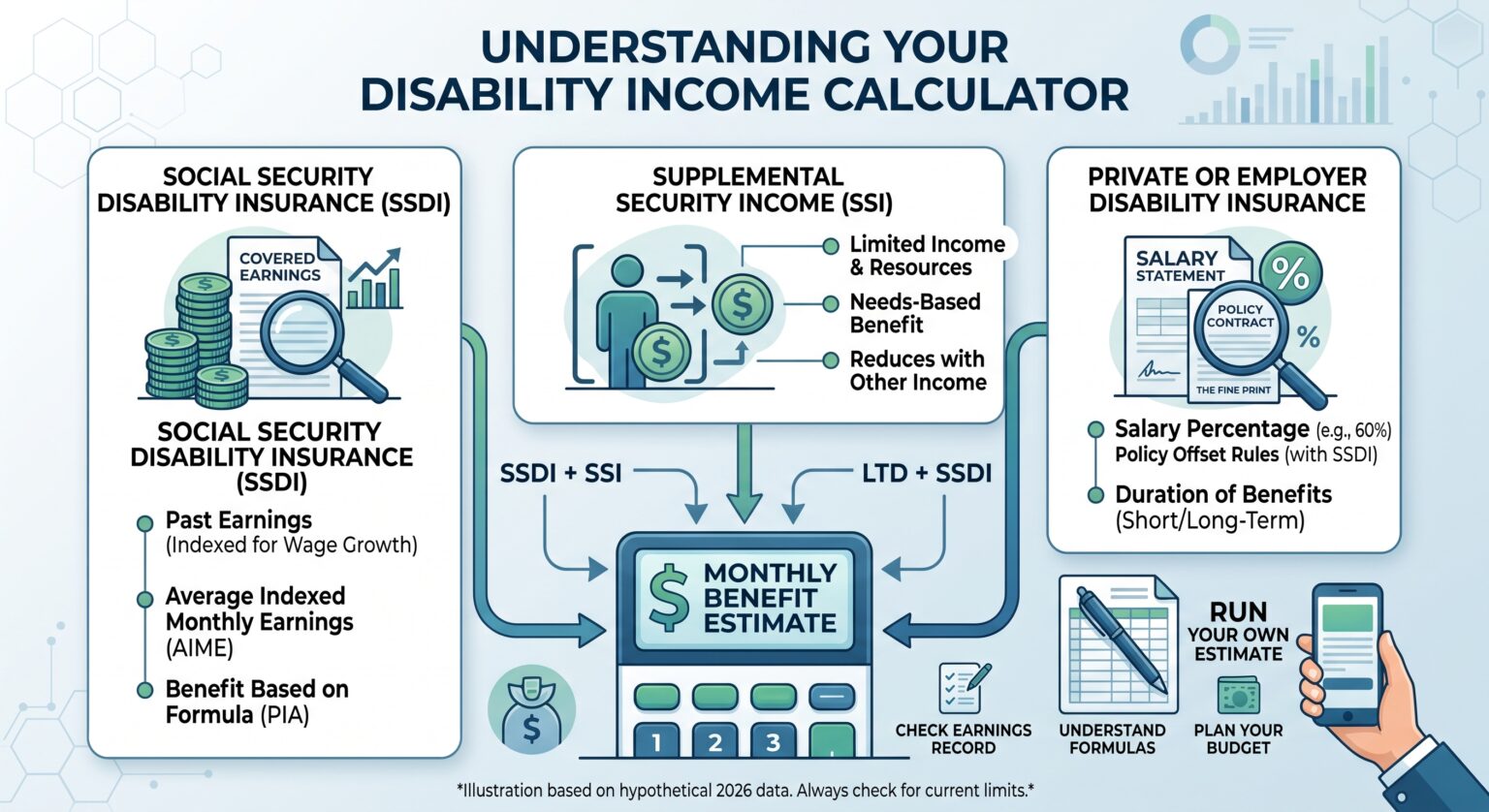
A disability income calculator answers one question: if you cannot work, how much money will actually arrive each month? The honest answer depends on which program pays you. Social Security Disability Insurance (SSDI) looks at your past earnings. Supplemental Security Income (SSI) looks at your current income and savings. A private or employer disability policy looks at your salary and the fine print of your contract.
Last updated: October 11, 2026. Figures reflect the 2026 Social Security Administration announcements.
Most online tools blur these three together, which is why people end up with an estimate that is off by hundreds of dollars. This guide separates them, shows the exact 2026 formulas Social Security uses, and walks through real numbers so you can run your own estimate in five minutes with a pen or a spreadsheet. To check how your own earnings history translates into benefits, you can also try our Social Security benefits calculator.
The short version for 2026: the average disabled worker on SSDI receives about $1,630 a month, SSI pays a maximum federal rate of $994 for an individual, and you can earn up to $1,690 a month (before disability-related work expenses) without automatically being found to be working at a substantial level. SSDI and SSI payments rose 2.8% in January 2026, while wage-based limits such as the SGA earnings limit rose by a larger 4.3%.
Heads-up: Social Security announces its cost-of-living adjustment and updated limits every October. The 2027 figures are expected in mid-October 2026, so check the “last updated” date at the top of this page before relying on any number.
What a Disability Income Calculator Really Measures
There is no single “disability income.” Depending on your situation you may be estimating one of three different payments:
- SSDI is an insurance benefit. You qualify by working and paying Social Security taxes, and the amount depends on your lifetime covered earnings. Your medical condition decides whether you qualify, but not how much you receive.
- SSI is a needs-based benefit for people with limited income and resources. It pays a flat federal rate that shrinks as your other income grows.
- Private disability insurance (short-term or long-term, usually through an employer) typically replaces a percentage of your salary, often around 60%, for a set period.
You can receive more than one. Some people collect SSDI and a small SSI top-up, and many long-term disability policies are designed to work alongside SSDI rather than replace it. A good disability income calculator asks which of the three you are modeling before it gives you a number. If it doesn’t, treat the result as a rough guess.
2026 Disability Income Numbers You Need
Before you trust any tool, check that it uses current figures. These are the 2026 values published after the Social Security Administration (SSA) announced a 2.8% cost-of-living adjustment. You can verify them in the Federal Register notice for 2026 determinations.
| Item | 2025 | 2026 |
|---|---|---|
| Cost-of-living adjustment | 2.5% | 2.8% |
| Average monthly SSDI benefit (disabled worker, SSA estimate) | about $1,586 | about $1,630 |
| SSI federal maximum, individual | $967 | $994 |
| SSI federal maximum, couple | $1,450 | $1,491 |
| SGA limit, non-blind | $1,620 | $1,690 |
| SGA limit, statutorily blind | $2,700 | $2,830 |
| Trial Work Period monthly threshold | $1,160 | $1,210 |
| Earnings needed for one work credit | $1,810 | $1,890 |
| Benefit formula bend points | $1,226 and $7,391 | $1,286 and $7,749 |
A quick warning: some sites still publish 2025 figures under a 2026 headline. If a tool tells you the SGA limit is $1,620, it is a year behind.
You will also see $4,152 quoted as the “maximum SSDI benefit.” That number is the top monthly benefit for someone retiring at full retirement age with a long career of maximum taxable earnings. Disabled workers usually stop working earlier and have shorter earnings histories, so very few come close to it. Use the average, not the maximum, as your reality check.
How to Estimate SSDI: The 3-Step Formula
SSA does not give you a lookup table. It runs your earnings through the same three steps every time, and you can reproduce them.
Step 1: Index your earnings
SSA takes your yearly covered earnings and adjusts older years upward to reflect wage growth. This keeps a paycheck from 1998 comparable to one from 2024.
Step 2: Find your AIME
Your Average Indexed Monthly Earnings (AIME) is your total indexed earnings across your “computation years,” divided by the number of months in those years. For retirement, SSA uses your best 35 years. For disability, the number of years is shorter and depends on your age when you became disabled, because a 30-year-old cannot have 35 working years.
The rule works like this: SSA counts the years from age 22 up to the year before you became disabled, then drops a number of your lowest years. The older you are, the more low years SSA lets you drop.
| Age when disability begins | Lowest years dropped |
|---|---|
| Under 27 | 0 |
| 27 to 31 | 1 |
| 32 to 36 | 2 |
| 37 to 41 | 3 |
| 42 to 46 | 4 |
| 47 or older | 5 |
SSA always uses at least two computation years. This is why a worker who becomes disabled at 45 after 23 years of steady pay usually gets a stronger AIME than someone with a patchy record: a few bad years get dropped, and the good ones carry the average.
Step 3: Apply the PIA formula
Your AIME becomes your Primary Insurance Amount (PIA), which is your monthly SSDI benefit before adjustments. For someone becoming eligible in 2026, the formula is:
- 90% of the first $1,286 of AIME, plus
- 32% of AIME between $1,286 and $7,749, plus
- 15% of AIME above $7,749
The result is rounded down to the next lower ten cents. The formula is deliberately tilted toward lower earners: the first slice of your earnings is replaced at 90%, the top slice at only 15%.
Worked examples
Here is what the formula produces at three common earnings levels (2026 bend points):
| AIME | Calculation | Monthly PIA | Share of AIME replaced |
|---|---|---|---|
| $2,000 | $1,157.40 + 32% of $714 ($228.48) | $1,385.80 | about 69% |
| $3,000 | $1,157.40 + 32% of $1,714 ($548.48) | $1,705.80 | about 57% |
| $5,000 | $1,157.40 + 32% of $3,714 ($1,188.48) | $2,345.80 | about 47% |
Notice the pattern. A worker who earned 2.5 times as much as the first person does not receive 2.5 times the benefit. This is the single most useful insight for planning: SSDI protects a base level of income, but it will not maintain a high earner’s lifestyle. If your household budget was built on a salary well above $5,000 a month, plan for a real gap.
SSDI Benefit by AIME Chart (2026 Bend Points)
Use this disability income calculator chart to find your approximate monthly SSDI benefit (PIA) from your Average Indexed Monthly Earnings. It applies the 2026 formula: 90% of the first $1,286, 32% of AIME between $1,286 and $7,749, and 15% above $7,749, rounded down to the next dime. Your real AIME comes from your SSA earnings record.
| AIME | Monthly benefit (PIA) | Share of AIME replaced |
|---|---|---|
| $1,000 | $900.00 | 90% |
| $1,500 | $1,225.80 | 82% |
| $2,000 | $1,385.80 | 69% |
| $2,500 | $1,545.80 | 62% |
| $3,000 | $1,705.80 | 57% |
| $4,000 | $2,025.80 | 51% |
| $5,000 | $2,345.80 | 47% |
| $6,000 | $2,665.80 | 44% |
| $7,000 | $2,985.80 | 43% |
| $8,000 | $3,263.20 | 41% |
The average disabled worker receives about $1,630 a month in 2026, which corresponds to an AIME of roughly $2,760 on this chart (1,157.40 + 32% of $1,477 = $1,630). For your own record, see your my Social Security account and our Social Security calculator.
Can You Get SSDI at All? The Work Credit Check
An estimate that skips eligibility will happily calculate a benefit you may not qualify for. SSDI requires enough work credits. In 2026, you earn one credit for each $1,890 in covered earnings, up to four credits a year, so $7,560 in earnings gets you a full year of credits.
Most adults need 40 credits, with 20 earned in the last 10 years before disability began. Younger workers need fewer, on a sliding scale. There is also a five-full-month waiting period, so benefits start with the sixth full month after your established onset date.
If you are close to the threshold, a single year of low earnings can matter more than any spreadsheet error. Check your earnings record before you apply, since mistakes on your record flow directly into your benefit. You can test how your covered earnings affect your monthly benefit with our Social Security estimate tool.
Estimating SSI: How Other Income Reduces Your Check
The SSI side of the math works backwards from SSDI. Instead of calculating what you earned, it starts at the federal maximum ($994 for an individual in 2026) and subtracts your countable income.
The core rules:
- The first $20 of most monthly income is excluded.
- For wages, the first $65 is also excluded, and then half of the rest is excluded.
- Resources are generally limited to $2,000 for an individual and $3,000 for a couple.
Example: you receive $700 a month in SSDI and have no other income. SSA excludes $20, counts $680, and subtracts it from $994. Your federal SSI payment is $314, so your combined income is $1,014 a month. Some states add their own supplement on top of the federal amount, and a few states handle SSI differently, so check your state’s rules.
This is the case where people are most often surprised. A small SSDI check plus a small SSI top-up can total more than either would alone, which is why anyone with a low earnings record should test both programs.
Estimating Private Disability Insurance
Private long-term disability (LTD) is the easiest to estimate and the easiest to misjudge. Most group policies replace roughly 50% to 70% of your pre-disability gross pay, and 60% is the most common figure.
Example: you earn $72,000 a year, or $6,000 a month. A 60% policy pays $3,600 a month.
Three details change that number:
- SSDI offsets. Many LTD policies reduce your payment by whatever SSDI you receive, and some require you to apply for SSDI as a condition of being paid. If your SSDI is $1,705.80, that same policy may pay about $1,894 from the insurer, for a combined $3,600. Your total does not go up, the insurer’s cost goes down.
- Benefit caps. Policies often cap monthly benefits at a fixed dollar amount, which hurts higher earners most.
- Taxes. If your employer paid the premiums with pre-tax dollars, the benefit is generally taxable income, so your take-home will be lower than the gross figure; our paycheck calculator shows the difference between gross and net pay. If you paid the premiums yourself with after-tax money, it is generally tax-free. That difference can be worth hundreds of dollars a month.
Read your policy’s definition of disability too. Many policies pay only if you cannot do your own occupation for the first two years, then switch to a stricter “any occupation” test.
How Much Can You Earn While Receiving Disability?
For SSDI, the key threshold is Substantial Gainful Activity (SGA). In 2026 it is $1,690 a month for most people and $2,830 for people who are statutorily blind. If your countable earnings are above that level, SSA may decide you are not disabled. To see what a monthly limit means in hourly pay, use our salary to hourly calculator.
SSDI also includes a Trial Work Period, which lets you test your ability to work without losing benefits right away. In 2026, the Trial Work Period amount is $1,210 a month before taxes, and a month at that level counts as a trial work month. You get nine such months within a rolling 60-month window, and the months do not need to be consecutive. After the nine months, a 36-month extended period of eligibility follows, during which you keep benefits for any month your earnings stay under the SGA limit.
Two practical points:
- SSA can subtract certain impairment-related work expenses when it measures your earnings against the SGA limit, so your gross pay is not always the number that counts.
- SSI treats earnings differently from SSDI. Earned income reduces an SSI check gradually rather than cutting it off at a hard line.
Why Your Disability Income Calculator Result May Not Match Your Real Check
Even a perfectly built estimate is still an estimate. These are the gaps that most often appear:
- Workers’ compensation or public disability payments. If you receive these, your SSDI can be reduced so the combined total does not exceed 80% of your average current earnings before disability.
- Unreported or missing earnings. Wages your employer never reported, or self-employment income you did not pay Social Security tax on, are invisible to SSA.
- The wrong onset year. The bend points depend on the year you become eligible. Someone whose eligibility starts in 2026 uses $1,286 and $7,749, and someone in 2025 uses $1,226 and $7,391.
- Family benefits. Eligible spouses and children may receive additional benefits on your record, subject to a family maximum.
- Annual COLA. After you become entitled, the benefit rises each year with cost-of-living adjustments, so your first check and your fifth check are not the same.
- Medicare timing. SSDI recipients generally become eligible for Medicare after 24 months of entitlement, which affects your real monthly costs even though it is not part of the payment.
The most accurate source is SSA itself, not any third-party tool. Your my Social Security account shows your actual earnings record and personalized benefit estimates. Use a calculator to plan, and use your SSA record to confirm.
Common Mistakes When Using a Disability Income Calculator
Using the wrong program. Someone with a long work record who enters SSI rules gets a number that is far too low. Someone with almost no work history who assumes SSDI will be disappointed.
Entering salary instead of covered earnings. Only earnings that were subject to Social Security tax count. Cash work, unreported income and some government jobs may not.
Ignoring the waiting period. The five-month wait means your budget needs to survive several months with no SSDI at all. Short-term disability, savings or family support usually have to cover it.
Planning around the maximum. The $4,152 figure is not your target. The average is closer to $1,630, and your own number comes from the formula above.
Forgetting taxes. SSDI benefits can be taxable when your total income is high enough: up to 50% of benefits may be taxable above $25,000 of combined income for a single filer, and up to 85% above $34,000. Many people on SSDI alone owe nothing, but a working spouse or other income can change that. Our income tax calculator can show where you land.
Disability Income Calculator FAQs: Your Top Questions Answered
How much disability will I get if I make $30,000 a year?
If your indexed earnings have averaged $30,000 a year, your AIME is $2,500 a month ($30,000 / 12), and the 2026 formula gives an SSDI benefit of about $1,545.80 a month. This assumes steady earnings over your computation years and enough work credits. Your real AIME comes from your SSA record, so a shorter or lower-paid record changes the result.
How much money do you get on disability in the USA?
It depends on the program. SSDI averages about $1,630 a month for a disabled worker in 2026. SSI pays up to $994 a month for an individual and $1,491 for a couple, reduced by other income. Private disability insurance usually replaces around 60% of salary.
How to calculate disability income?
For SSDI, index your earnings, find your AIME, then apply the 2026 formula: 90% of the first $1,286, 32% of the amount between $1,286 and $7,749, and 15% above $7,749. For SSI, start from the federal maximum and subtract your countable income. The steps are explained in detail above.
How much Social Security disability will I get if I make $60,000 a year?
With steady earnings of $60,000 a year, your AIME is $5,000 a month and the SSDI benefit is about $2,345.80 a month, which replaces roughly 47% of your AIME. Retirement benefits are calculated differently and depend on the age you claim.
Is there a Social Security disability pay chart for 2026?
Yes. The AIME chart above shows the 2026 benefit at each level, for example $900.00 at an AIME of $1,000, $1,545.80 at $2,500, $2,345.80 at $5,000 and $3,263.20 at $8,000.
How much is disability for a single person?
SSDI does not depend on marital status; it depends on your earnings record. For SSI, the 2026 federal maximum is $994 a month for an individual, before other income reduces it. Some states add a supplement.
Does age change my SSDI amount?
Age does not change the benefit formula, but it changes which years SSA counts. The older you were when disability began, the more of your lowest-earning years SSA drops (up to five at 47 or older), which can raise your AIME.
How much disability income can I get per month?
It depends on the program. SSDI averages about $1,630 in 2026 and ranges widely with your earnings history. SSI pays up to $994 for an individual before other income reduces it. Private disability insurance typically pays around 60% of your salary, subject to caps and offsets.
How is disability income calculated?
For SSDI, SSA indexes your past earnings, averages them into your AIME, and applies the 90/32/15 percent formula at the 2026 bend points of $1,286 and $7,749. SSI starts from the federal maximum and subtracts your countable income. Private insurance applies the percentage written in your policy.
What is the average monthly disability payment in 2026?
About $1,630 for a disabled worker on SSDI, according to SSA’s estimate after the 2.8% cost-of-living adjustment. The average is far more realistic for planning than the maximum.
Does the severity of my condition change how much I get?
No. Severity and diagnosis affect whether you are approved, but SSDI is calculated from your earnings record alone.
How much can I earn while on disability?
For SSDI, the SGA limit is $1,690 a month in 2026 ($2,830 if you are blind). You also have a Trial Work Period, where months at the $1,210 level do not immediately end your benefits. SSI has separate rules that reduce the check gradually as you earn.
Can I get disability if I only worked part-time?
Possibly. Credits are based on dollars earned, not hours worked, and $1,890 in earnings gives you one credit in 2026. If your record is short, SSI may also be worth checking.
Is disability income taxable?
SSDI can be partly taxable at higher combined income levels, as described above. SSI is not taxable. Private disability benefits are taxable or tax-free depending on who paid the premiums and how.
Is a disability income calculator accurate?
It is accurate only to the extent that your inputs are. A good tool gets you within a reasonable range. Your official SSA earnings record gives you the number that will actually be paid.
Your Next Step
Run your estimate in three passes: first, check your work credits; second, calculate your AIME and PIA using the formula above; third, test whether SSI or a private policy adds to the total. Then compare the result to your real monthly costs so you know your gap before a claim decision is made.
A disability income calculator will not tell you whether you qualify, and it cannot replace your SSA record. What it does well is turn a confusing system into a number you can plan around, and that is often the difference between a manageable budget and a crisis.
Ready to run your numbers? Start with our free Social Security calculator, then check your take-home pay with the paycheck calculator.
This article is general information for planning, not legal or financial advice. Consider speaking with a qualified benefits professional before making major decisions.
Sources
- Cost-of-Living Increase and Other Determinations for 2026, Federal Register
- Quarter of Coverage, SSA Office of the Chief Actuary
- Try returning to work without losing Disability, SSA
- 2026 Cost-of-Living Adjustment Fact Sheet, SSA
- Primary Insurance Amount formula and bend points, SSA Office of the Chief Actuary