
When you start a new job and hear you will be paid biweekly, a few questions come up quickly. How many paychecks will you get in a year? How much will each one be? And why is the deposit smaller than the salary divided by 26? The answers are simple once you separate gross pay from take-home pay.
To see your own number, use our free Paycheck Calculator. This guide explains how biweekly pay works and shows what common salaries look like per paycheck.
Last reviewed: October 9, 2026. Figures reflect 2026 federal rules for a single filer.
What Does Biweekly Pay Mean?
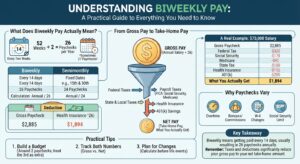
Biweekly pay means you are paid every two weeks, or every 14 days. A year has about 52 weeks, so a biweekly schedule usually gives you 26 paychecks a year (52 ÷ 2). It is common in the United States because it gives employees frequent access to their pay while letting employers run payroll every two weeks instead of every week.
Do You Get 26 or 27 Paychecks?
Most years contain 26 biweekly paydays, but some calendars produce 27. A year does not divide evenly into 14-day periods, so every so often an extra payday falls in the same calendar year. For a salaried employee the extra paycheck is not a raise, it is a calendar effect. Do not build it into your regular budget until payroll confirms it. Use it for savings, debt repayment or other goals.
How Much Is a Biweekly Paycheck?
For a salaried employee, the basic formula is annual salary ÷ 26 = gross biweekly pay. The chart below shows gross pay and estimated take-home pay per paycheck for a single filer using the 2026 standard deduction and federal brackets, plus Social Security and Medicare, with no pre-tax deductions. The last column adds an example 5% state income tax.
| Annual salary | Gross biweekly pay | Take-home, no state tax | Take-home, 5% state tax |
|---|---|---|---|
| $30,000 | $1,153.85 | $1,010.96 | $953.27 |
| $40,000 | $1,538.46 | $1,320.00 | $1,243.08 |
| $50,000 | $1,923.08 | $1,629.04 | $1,532.88 |
| $60,000 | $2,307.69 | $1,938.08 | $1,822.69 |
| $75,000 | $2,884.62 | $2,368.94 | $2,224.71 |
| $90,000 | $3,461.54 | $2,774.81 | $2,601.73 |
| $100,000 | $3,846.15 | $3,045.38 | $2,853.08 |
For example, $50,000 a year is $1,923.08 gross every two weeks, and about $1,629.04 after federal tax and FICA in a state with no income tax. Your own result changes with your W-4, benefits and state, so enter your details in the paycheck calculator.
Where Does Your Biweekly Pay Go?
Federal income tax
Withholding depends partly on your Form W-4: filing status, dependents and any extra withholding you request. Use our tax bracket calculator to see where your income falls.
Payroll taxes (FICA)
Social Security is 6.2% for employees, up to the 2026 taxable maximum of $184,500, and Medicare is 1.45% with no cap. An additional 0.9% Medicare tax applies to wages above $200,000. You can verify the limits in the Social Security Administration’s 2026 fact sheet.
State and local taxes
Some states have no income tax, while others withhold from wages, and some cities add their own taxes. Your work location can make a noticeable difference in take-home pay.
Benefits and other deductions
Your share of health insurance premiums, 401(k) contributions, HSA or FSA contributions, union dues and garnishments can also come out of each paycheck. To see how a contribution changes your savings, use the 401(k) calculator.
A Biweekly Paycheck With Pre-Tax Deductions
Suppose a single employee earns $75,000, lives in a state that withholds about $100 per paycheck, pays $150 per paycheck for health insurance and contributes $200 per paycheck to a 401(k). Health insurance is deducted before federal tax and FICA, and the 401(k) contribution is deducted before federal tax only. An estimated breakdown:
| Item | Per paycheck |
|---|---|
| Gross pay ($75,000 ÷ 26) | $2,884.62 |
| Health insurance (pre-tax) | −$150.00 |
| 401(k) contribution (pre-tax) | −$200.00 |
| Federal income tax | −$220.31 |
| Social Security (6.2%) | −$169.55 |
| Medicare (1.45%) | −$39.65 |
| State tax (example) | −$100.00 |
| Estimated take-home pay | $2,005.11 |
This is an example, not a guarantee. Because the 401(k) and health premiums come out before tax, this employee’s take-home is lower than the no-deduction figure in the chart, but part of that money is going into their own savings and benefits.
Why Is Everyone’s Biweekly Pay Different?
- Filing status and dependents differ.
- States and cities tax wages differently.
- Retirement contributions and health plans vary.
- Some people have extra income or requested extra withholding.
So treat any online estimate as a guide rather than an exact promise.
Hourly Workers and Biweekly Pay
For hourly employees: hourly rate × hours worked in two weeks = gross biweekly pay. At $25 an hour for 80 hours, that is $2,000 gross. Overtime is counted by the workweek, not the two-week period: working 45 hours in week one and 35 in week two can create overtime in week one even though the period totals 80 hours. Use our overtime calculator and the hourly to salary calculator for your numbers.
Biweekly vs. Semi-Monthly Pay
| Biweekly | Semi-monthly |
|---|---|
| Paid every 14 days | Paid twice a month |
| 26 paychecks a year | 24 paychecks a year |
| Paydays move through the calendar | Paydays fall on fixed dates |
| Some months have three paychecks | Every month has two |
| Salary divided by 26 | Salary divided by 24 |
A $60,000 salary pays $2,307.69 gross per biweekly paycheck or $2,500 per semi-monthly paycheck. The annual total is the same; only the timing and size of each paycheck change. Neither schedule is automatically better: biweekly suits people who like frequent pay and extra savings in three-paycheck months, while semi-monthly suits people whose bills fall on fixed monthly dates.
Practical Tips for Living on Biweekly Pay
- Budget around two paychecks a month. Use any third paycheck for an emergency fund, extra debt payments or savings goals.
- Compare every pay stub with your expectations: hours, rate, withholding, insurance and retirement deductions.
- Recalculate after big changes: a raise, new job, marriage, a child, a move to another state or a new W-4.
Frequently Asked Questions
How much is $50,000 a year in biweekly pay?
$1,923.08 gross ($50,000 ÷ 26). Take-home is lower after taxes and deductions; the chart above shows about $1,629.04 with no state tax.
Do I really get 27 paychecks in some years?
Possibly. It depends on your employer’s payroll calendar. Do not count on it in your normal budget until payroll confirms it.
Why is my paycheck less than expected?
The salary in an offer is gross pay. Federal tax, payroll taxes, state tax, insurance, retirement contributions and other deductions reduce what you receive.
Can I change how much federal tax is withheld?
Generally yes. Give your employer an updated Form W-4. The IRS Tax Withholding Estimator can help you choose the right amount.
Are gross pay and net pay the same?
No. Gross pay is what you earn before deductions; net pay is what you receive after them. Use net pay for your personal budget.
The Bottom Line
Biweekly pay means a paycheck every 14 days, usually 26 a year. Divide your annual salary by 26 for gross pay, then remember that taxes and deductions can take a large share before the deposit. Use the Paycheck Calculator to see your real take-home pay, and read our guide to calculating your paycheck for the full method.