
If you freelance, drive for a rideshare app, run a one-person LLC or bill clients as an independent contractor, nobody withholds Social Security and Medicare from your pay the way an employer would for a W-2 worker. That job falls on you, and it is usually the tax bill that surprises new freelancers most, because it is calculated on top of your regular income tax, not instead of it.
Want your number now? Use our free Self-Employment Tax Calculator to estimate your self-employment tax and federal income tax. Then read on to understand how the number is built, so you can lower it, set aside the right amount each quarter and avoid a shock at filing time.
Last reviewed: October 9, 2026. Figures reflect the 2026 tax year. This article is educational and does not replace advice from a licensed CPA or tax attorney.
What Self-Employment Tax Covers
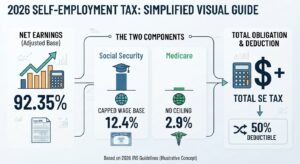
Self-employment tax is not an extra tax invented for freelancers. It is the same Social Security and Medicare funding that comes out of every W-2 employee’s paycheck under FICA. The difference is who pays it. An employee and employer each pay 7.65% (6.2% Social Security plus 1.45% Medicare), which adds up to 15.3%. When you are self-employed there is no employer to cover the other half, so you pay the full 15.3% yourself, as the IRS explains in Topic No. 554.
You generally owe self-employment tax if your net self-employment earnings are $400 or more in the year, even if you also have a W-2 job.
The 2026 Self-Employment Tax Rate, Piece by Piece
1. The 92.35% Net Earnings Factor
Before any rate is applied, you reduce your net profit by 7.65% to account for the employer-equivalent half that would never have counted as income. Net profit × 92.35% = net earnings from self-employment.
2. The 12.4% Social Security Portion (Capped)
This applies only up to the annual Social Security wage base. For 2026 that base is $184,500, up from $176,100 in 2025, according to the Social Security Administration. If you also earned W-2 wages, those count first against the cap, so your self-employment income only fills the room left below $184,500.
3. The 2.9% Medicare Portion (Uncapped)
Medicare tax applies to all of your net earnings with no ceiling. Every dollar above the Social Security wage base is still taxed at 2.9%.
4. The 0.9% Additional Medicare Tax (High Earners)
If combined wages and self-employment income exceed $200,000 (single or head of household), $250,000 (married filing jointly) or $125,000 (married filing separately), you owe an extra 0.9% Medicare tax on the amount above the threshold. There is no employer half to offset it.
How to Calculate Self-Employment Tax: A Step-by-Step Example
Take a single freelance designer with $90,000 in net Schedule C profit and no other W-2 income in 2026:
- Apply the 92.35% factor: $90,000 × 0.9235 = $83,115 of net earnings.
- Social Security portion: $83,115 is under the $184,500 cap, so $83,115 × 12.4% = $10,306.26.
- Medicare portion: $83,115 × 2.9% = $2,410.34.
- Add them: $10,306.26 + $2,410.34 = $12,716.60 total self-employment tax.
- Claim the deduction: half of it, $6,358.30, is deductible on Schedule 1, which lowers your income tax base but not the self-employment tax itself.
Because this income is below $200,000, no Additional Medicare Tax applies.
Self-Employment Tax vs. Income Tax vs. Freelance Tax
- Self-employment tax: the 15.3% Social Security and Medicare obligation covered here.
- Income tax: calculated separately from your total taxable income and filing bracket.
- Freelance tax: an umbrella term for your total tax burden, self-employment tax plus income tax plus estimated payments. For the full picture, including quarterly dates and deductions, read our freelance taxes guide.
Self-Employment Tax by Income Level (2026)
| Net profit | Net earnings (× 92.35%) | Social Security (12.4%) | Medicare (2.9%) | Total SE tax |
|---|---|---|---|---|
| $30,000 | $27,705.00 | $3,435.42 | $803.45 | $4,238.87 |
| $60,000 | $55,410.00 | $6,870.84 | $1,606.89 | $8,477.73 |
| $90,000 | $83,115.00 | $10,306.26 | $2,410.34 | $12,716.60 |
| $150,000 | $138,525.00 | $17,177.10 | $4,017.23 | $21,194.33 |
| $200,000 | $184,700.00 | $22,878.00 | $5,356.30 | $28,234.30 |
| $250,000 | $230,875.00 | $22,878.00 | $6,695.38 | $29,573.38 |
The Social Security portion stops growing once your net earnings reach the $184,500 wage base, which happens at a net profit of about $199,783. Above that, only the 2.9% Medicare rate (plus any Additional Medicare Tax) continues to apply. Figures here exclude Additional Medicare Tax. To run your own number, use the Self-Employment Tax Calculator.
The Half-SE-Tax Deduction: Do Not Leave It Unclaimed
One of the most overlooked breaks for self-employed filers is the deduction for one half of self-employment tax, taken as an adjustment on Schedule 1 of Form 1040. It mirrors the fact that an employer’s matching FICA contribution would not be taxable income for a W-2 employee. It lowers your adjusted gross income, which can help you qualify for other deductions and credits, but it does not reduce the self-employment tax you owe.
Six Common Self-Employment Tax Mistakes
- Applying 15.3% to gross revenue instead of net profit. The tax is based on net earnings after business expenses.
- Forgetting the 92.35% factor. Skipping it overstates your self-employment tax by about 8%.
- Assuming Medicare caps out like Social Security. It does not; the 2.9% (3.8% for high earners) keeps applying.
- Skipping quarterly estimated payments. With no employer withholding, the IRS expects payments during the year, and underpaying can trigger a penalty. See our freelance taxes guide for the dates and safe harbor rules.
- Double-counting W-2 wages against the Social Security cap. Wages count first, so your self-employment cap is what remains.
- Confusing the half-SE-tax deduction with a cut in what you owe. It lowers your income tax base, not your Social Security and Medicare bill.
Frequently Asked Questions
Do I owe self-employment tax if I also have a full-time job?
Yes, if your net self-employment earnings are $400 or more. Your wages count first against the Social Security wage base, so your self-employment income may only be subject to the 12.4% portion on whatever room is left below $184,500.
Is self-employment tax the same as income tax?
No. Self-employment tax funds Social Security and Medicare. You still owe federal, and often state, income tax on your net profit at your regular brackets.
How often do I need to pay self-employment tax?
Most self-employed people pay through quarterly estimated payments rather than one lump sum, since no employer withholds it during the year.
Can I lower my self-employment tax by forming an LLC or S-corp?
An LLC taxed as a sole proprietorship does not change self-employment tax. Electing S-corp status can shift part of your income into distributions that are not subject to self-employment tax, but it adds payroll requirements and costs, so review it with a CPA before deciding.
What happens if I do not pay enough during the year?
You may owe an underpayment penalty on top of the tax, even if you pay the full balance when you file. Estimating early and adjusting your quarterly payments is the most reliable way to avoid it.
If You Are Self-Employed in Canada
This guide covers U.S. self-employment tax. Self-employed Canadians contribute to the Canada Pension Plan (CPP) through their tax return instead, so a U.S. calculator will not give an accurate number for a Canadian return.
Try the Self-Employment Tax Calculator
Doing the 92.35% factor, the wage base cap and the Additional Medicare Tax by hand is possible, but a small mistake can throw off your quarterly payments. Run your net profit through the Self-Employment Tax Calculator for your estimated 2026 liability, then set your prices with the freelance rate calculator.
Sources
- IRS Topic No. 554: Self-Employment Tax
- Social Security Administration: 2026 fact sheet
- IRS: Self-Employed Individuals Tax Center