

If you are trying to estimate how much you may owe, using a reliable federal income tax calculator is the smartest first step.
Want a quick number? Use our free Income Tax Calculator to estimate your federal tax, or the Tax Bracket Calculator to see your marginal and effective rate.
Last reviewed: October 9, 2026. Figures reflect the 2026 tax year.
It is crucial to understand that your tax is not simply a flat percentage of your salary. Your federal income tax depends on your taxable income, filing status, deductions, adjustments, credits, and other factors.
While a federal income tax calculator can make the process easier, understanding how the number is produced helps you interpret the result correctly.
This guide focuses on Tax Year 2026. Tax Year 2026 refers to income earned during 2026, with federal tax returns generally filed in 2027.
The examples below use 2026 federal tax rules and clearly stated assumptions. The IRS is the primary source for the tax brackets and standard deductions used here.
How Federal Income Tax Is Calculated
Federal income tax is generally calculated using taxable income, not simply your gross salary.
A simplified way to understand the process is:
Gross income → adjustments → adjusted gross income (AGI) → deductions → taxable income → federal income tax → credits → final tax liability
The exact calculation can be more complicated. Different types of income and deductions may receive different tax treatment.
For a basic wage earner, the important distinction is between these terms:
- Gross income: The income you receive before applicable adjustments and deductions.
- Adjusted gross income (AGI): Your gross income after applicable adjustments to income.
- Taxable income: The amount actually subjected to federal income tax rates after applicable deductions.
- Federal income tax: The tax calculated on taxable income before considering certain credits.
- Tax withholding: The amount your employer has already sent to the government on your behalf. Withholding is not your final tax liability.
For a broader estimate, you can also use our comprehensive Income Tax Calculator.
The most important point is that your salary and your taxable income are not necessarily the same number.
2026 Federal Income Tax Brackets and Standard Deduction
The United States uses a progressive federal income tax system. This means different portions of your taxable income are taxed at different rates.
For 2026, the federal income tax rates for a single filer are:
| Tax Rate | 2026 Taxable Income |
|---|---|
| 10% | $0–$12,400 |
| 12% | Over $12,400–$50,400 |
| 22% | Over $50,400–$105,700 |
| 24% | Over $105,700–$201,775 |
| 32% | Over $201,775–$256,225 |
| 35% | Over $256,225–$640,600 |
| 37% | Over $640,600 |
These are taxable-income brackets, not gross-income brackets.
The 2026 standard deduction is:
| Filing Status | 2026 Standard Deduction |
|---|---|
| Single | $16,100 |
| Married Filing Jointly | $32,200 |
| Married Filing Separately | $16,100 |
| Head of Household | $24,150 |
The IRS confirms these 2026 amounts. You can verify the latest updates on the official IRS page for federal income tax rates and brackets.
The standard deduction is vital because it directly reduces the amount of income subject to federal income tax.
If you want to see how different brackets affect a specific level of taxable income, the Tax Bracket Calculator can help illustrate the calculation.
Federal Income Tax by Income Level (2026, Single Filer)
This chart applies the 2026 brackets and the $16,100 standard deduction to common salaries. It assumes a single filer with no other adjustments, itemized deductions or credits, and it shows federal income tax only (not FICA or state tax).
| Gross income | Taxable income | Federal income tax | Marginal rate | Effective rate |
|---|---|---|---|---|
| $30,000 | $13,900 | $1,420 | 12% | 4.7% |
| $40,000 | $23,900 | $2,620 | 12% | 6.6% |
| $50,000 | $33,900 | $3,820 | 12% | 7.6% |
| $60,000 | $43,900 | $5,020 | 12% | 8.4% |
| $75,000 | $58,900 | $7,670 | 22% | 10.2% |
| $100,000 | $83,900 | $13,170 | 22% | 13.2% |
| $150,000 | $133,900 | $24,734 | 24% | 16.5% |
| $200,000 | $183,900 | $36,734 | 24% | 18.4% |
2026 Federal Brackets for Married Filing Jointly
Married couples filing jointly use wider brackets and a $32,200 standard deduction:
| Rate | Taxable income |
|---|---|
| 10% | $0 to $24,800 |
| 12% | Over $24,800 to $100,800 |
| 22% | Over $100,800 to $211,400 |
| 24% | Over $211,400 to $403,550 |
| 32% | Over $403,550 to $512,450 |
| 35% | Over $512,450 to $768,700 |
| 37% | Over $768,700 |
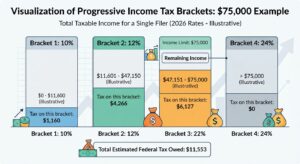
Federal Income Tax Example: $75,000 Salary in 2026
Consider a single taxpayer earning $75,000 in gross income during 2026.
Assumptions:
- Single filer
- Gross income: $75,000
- Adjustments: $0
- Standard deduction: $16,100
- No itemized deductions or tax credits
- Federal income tax only
Step 1: Calculate taxable income
Gross income: $75,000
Less standard deduction: $16,100
Taxable income: $58,900
Step 2: Apply the 2026 tax brackets
The first $12,400 is taxed at 10%:
$12,400 × 10% = $1,240
The next $38,000 falls in the 12% bracket:
$38,000 × 12% = $4,560
The remaining $8,500 falls in the 22% bracket:
$8,500 × 22% = $1,870
Add the three amounts:
$1,240 + $4,560 + $1,870 = $7,670
Under these assumptions, the estimated 2026 federal income tax is $7,670.
This example demonstrates why it is incorrect to simply multiply $58,900 by 22%. The taxpayer is in the 22% marginal tax bracket, but only the portion of taxable income above $50,400 is taxed at 22%. The earlier portions are taxed at 10% and 12%.
How Much Federal Income Tax Do I Pay on $200,000?
A common search is: How much federal income tax do I pay on $200,000?
There is no single answer without knowing your filing status. However, we can demonstrate the calculation using the same assumptions as the $75,000 example.
Assume:
- Single filer, Tax Year 2026
- Gross income: $200,000
- $0 adjustments, Standard deduction of $16,100
- No itemized deductions, tax credits, or other income
Taxable income would be:
$200,000 − $16,100 = $183,900
For a single filer, $183,900 of taxable income falls into the 24% marginal bracket.
Using the 2026 single-filer rate schedule:
- First $12,400 at 10% = $1,240
- Next $38,000 at 12% = $4,560
- Next $55,300 at 22% = $12,166
- Remaining $78,200 at 24% = $18,768
Total Estimated Tax:
$1,240 + $4,560 + $12,166 + $18,768 = $36,734
Under these specific assumptions, the estimated federal income tax on $200,000 of gross income is $36,734.
That does not mean someone earning $200,000 automatically owes this exact amount. Filing status, deductions, credits, and other applicable tax rules can change the actual result.
Marginal vs. Effective Tax Rate
Two tax rates are especially important when interpreting a federal income tax calculator: your marginal tax rate and your effective tax rate.
Marginal tax rate
Your marginal tax rate is the rate applied to your next dollar of taxable income within the applicable bracket.
In the $75,000 example, taxable income is $58,900. Therefore, the taxpayer’s marginal federal income tax rate is 22%. This does not mean the taxpayer pays 22% on all $58,900.
Effective tax rate
The effective rate looks at the overall federal income tax compared with the total income used in the calculation.
For the $75,000 example:
$7,670 ÷ $75,000 = 10.23%
So, the federal income tax is 10.23% of gross income under these assumptions.
The two percentages answer different questions:
- Marginal rate: What rate applies to the next portion of taxable income?
- Effective rate: How large is the calculated tax compared to your total income?
This distinction is one of the most important things to understand when using any tax tool.
Does a Raise Push You Into a Higher Tax Bracket?
Yes, a raise can cause some of your taxable income to enter a higher marginal tax bracket.
However, entering a higher bracket does not mean your entire income is suddenly taxed at that higher rate.
Suppose part of a taxpayer’s additional income moves above the threshold for a higher bracket. The higher rate applies only to the portion that falls within that higher bracket. The income that remains in the lower brackets continues to be taxed at the lower rates.
This is why the phrase “the raise pushed me into the 22% bracket” is misleading. It does not mean every dollar of your income is now taxed at 22%.
A raise can increase your federal income tax, but the higher marginal rate applies only to the relevant portion of taxable income.
Federal Income Tax vs. FICA and State Income Tax
Federal income tax is not the same thing as FICA (Social Security/Medicare) or state income tax.
These taxes can all affect your paycheck, but they serve different purposes and are calculated under different rules.
- Federal income tax: Calculated under the federal income tax system and its applicable brackets, deductions, and credits.
- Social Security tax: Part of FICA, generally withheld from employees’ wages separately from federal income tax.
- Medicare tax: The other primary component of FICA. Additional Medicare Tax can apply to certain higher-income taxpayers.
- State income tax: Imposed by individual states under their own rules. Some states have no individual income tax at all.
Therefore, the $7,670 calculated in the $75,000 example is federal income tax only. It is not the taxpayer’s total payroll tax or total tax burden. For a complete picture, consider using a Paycheck Calculator to estimate your true take-home pay.
Federal and State Income Tax Calculator
A federal and state income tax calculator combines two different calculations.
The federal portion uses federal tax rules. The state portion depends on the state in which the taxpayer is subject to state income tax.
This matters because state income tax rules can differ substantially from federal rules. A state may have different brackets, deductions, exemptions, credits, or no individual income tax at all.
For that reason, you should not assume that a federal tax estimate automatically tells you how much state income tax you will owe.
If you are looking specifically for a state income tax calculator, you need to enter or select the applicable state because the answer depends entirely on state-specific rules.
Self-Employed? Federal Income Tax vs. Self-Employment Tax
Self-employed taxpayers need to distinguish between federal income tax and self-employment tax. They are not the same tax.
Self-employment tax primarily consists of Social Security and Medicare taxes. The IRS states that the self-employment tax rate is generally 15.3%, subject to applicable rules and limitations.
Self-employment tax is generally calculated using net earnings from self-employment. It is not simply 15.3% applied to gross business revenue.
The IRS generally uses 92.35% of net earnings from self-employment as the amount subject to this tax.
For example, a self-employed person may first calculate business income after allowable business expenses. That business profit can then be relevant to both self-employment tax and federal income tax, but the two taxes are calculated separately.
The IRS also allows the employer-equivalent portion of self-employment tax as an adjustment when calculating AGI.
If you have freelance, contractor, or business income, the Self-Employment Tax Calculator can help you estimate the self-employment-tax portion separately.
How to Use a Federal Income Tax Calculator
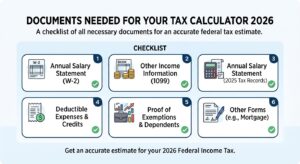
A federal income tax calculator is most useful when you give it accurate information.
Depending on the tool, you may be asked for several details. Here is how to prepare:
1. Enter your income
Start with the income relevant to the calculator. For an employee, this may be wages or salary. Someone with multiple sources of income may need to include additional taxable income.
2. Select your filing status
Your filing status can significantly change the applicable tax brackets and standard deduction. A single taxpayer and a married couple filing jointly do not use the same 2026 tax brackets.
3. Account for deductions
The standard deduction reduces taxable income. Some taxpayers may instead qualify to itemize deductions. Remember the 2026 standard deductions: $16,100 (Single), $32,200 (Married Filing Jointly), and $24,150 (Head of Household).
4. Include applicable adjustments
Certain adjustments can reduce AGI before taxable income is calculated. The exact adjustments available depend on your specific circumstances.
5. Include tax credits
A tax credit is different from a deduction. A deduction reduces the income subject to tax. A credit generally reduces the tax after the calculation. Because credits can materially change the final result, a calculator that ignores them may not provide a complete estimate.
6. Understand what the result represents
Before comparing your calculator result with your paycheck, determine what the result represents. Is it your federal income tax liability, total federal taxes, estimated withholding, or potential refund? These are not interchangeable figures.
For additional tax calculations, you can also explore our full Tax Calculators category.
Why Your Calculator Result May Differ From Your Actual Tax
A calculator provides an estimate based on the information entered. Your actual federal tax return can produce a different result.
This happens because your real tax situation may include details that a basic calculator does not capture. Possible differences can come from:
- Filing status changes
- Adjustments to income or retirement contributions
- Standard or itemized deductions
- Tax credits or dependents
- Investment income or capital gains
- Business or self-employment income
There can also be a major difference between tax liability and withholding.
If your employer withheld $10,000 for federal income tax, but your final federal income tax liability is $7,670, the two numbers are not contradictory.
Withholding represents payments made during the year. Your final tax liability is determined only when your tax return is calculated.
The difference between those amounts can contribute to a refund or balance due, subject to the rest of your return.
Frequently Asked Questions
How is federal income tax calculated?
Federal income tax is generally calculated using taxable income and the tax rates applicable to the taxpayer’s filing status. A simplified calculation starts with income, accounts for applicable adjustments and deductions, determines taxable income, and then applies the progressive federal tax brackets.
What is a federal income tax calculator for 2026?
A federal income tax calculator 2026 estimates federal income tax using 2026 tax rules and the information entered by the user, such as income, filing status, deductions, adjustments, and credits. The result is an estimate rather than a completed tax return.
How does a federal income tax rate calculator work?
A federal income tax rate calculator applies the applicable federal tax brackets to taxable income. Because the U.S. federal income tax system is progressive, different portions of taxable income can be taxed at different rates.
How does a federal income tax rate calculator work for a single person?
A single taxpayer uses the federal tax brackets and standard deduction applicable to the Single filing status. For 2026, the standard deduction for a single filer is $16,100.
Is there a free tax calculator?
Yes. A free tax calculator can provide an estimate of federal income tax without requiring a paid tax-preparation service. The usefulness of the estimate depends on the accuracy of the information entered.
Can I use a state income tax calculator with a federal tax calculator?
Yes, but the calculations should be treated separately because federal and state income taxes follow different rules. A federal estimate does not automatically determine your state income tax.
What is the difference between marginal and effective tax rate?
The marginal tax rate is the rate applied to the next portion of taxable income within the applicable bracket. The effective tax rate measures the overall tax as a percentage of the income being used for the comparison.
Does a raise push you into a higher tax bracket?
A raise can cause some taxable income to enter a higher tax bracket, but the higher rate generally applies only to the portion that falls within that bracket. It does not retroactively change the tax rate applied to all of your previous taxable income.
Can a federal income tax calculator replace my tax return?
No. A calculator is an estimate based on assumptions. An actual federal tax return accounts for the taxpayer’s complete tax situation and applicable tax forms, deductions, credits, and provisions.
Disclaimer: These calculations are estimates based on applicable 2026 federal tax rules and the assumptions shown. They are not a substitute for filing an actual tax return or obtaining professional tax advice.
Sources
- IRS: Federal income tax rates and brackets
- IRS Tax Withholding Estimator
- IRS Topic No. 554: Self-Employment Tax